About Harmandiola tremulae (Winnertz, 1853)
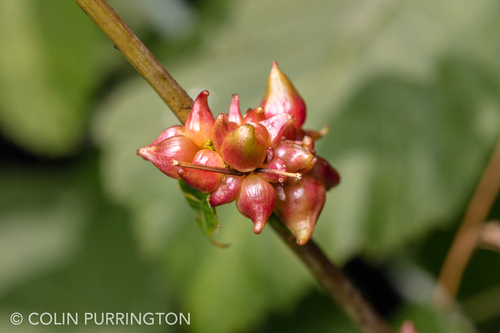
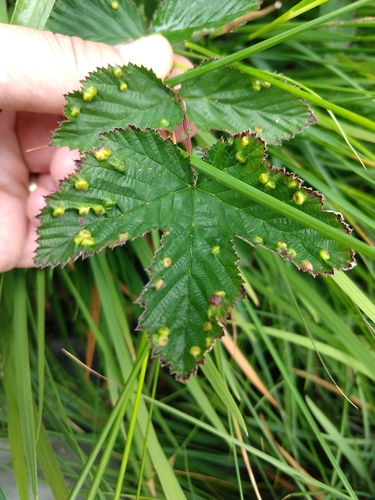
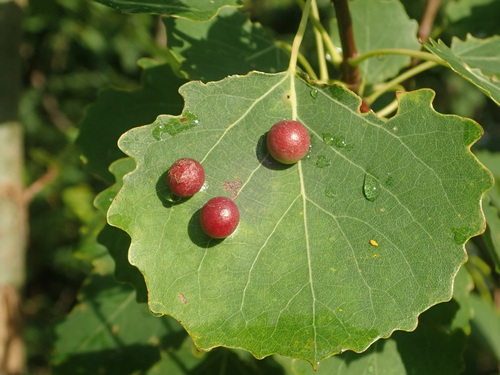
Scientific name: Harmandiola tremulae (Winnertz, 1853). The larvae of this species live in galls formed on the leaves of Populus tremula, and two distinct gall forms can be found. The first form is the size of a pea, can be green, red, or a mix of green and red, has a hard texture, and a slightly wrinkled surface. This form grows in clusters on leaf surfaces or leaf veins. The second form is much smaller. It is usually yellowish, but may also be red or green. Its internal tissue is typically looser, spongy or pithy, and contains a small single-chambered cavity where the larva develops. These galls are usually not perfectly round; because they grow clustered close together on the leaf surface, they become angular from pressing against one another. Both types of galls open on the underside of the leaf, and only rarely open on the leaf side. The galls mature in August and September, then release their larvae into the ground. Larvae complete their development either in autumn or the following spring. The author states that he cannot agree with Winnertz regarding these two gall forms. Winnertz considered them to be varieties of a single previous gall form, but based on the author's experience, these two forms should be classified as independent forms. This text was translated from Dr. F. Rudow's 'Overview of the gall formations that occur in Tilia, Salix, Populus, Artemisia, along with comments on some other galls'.