About Harfordia macroptera Greene & Parry
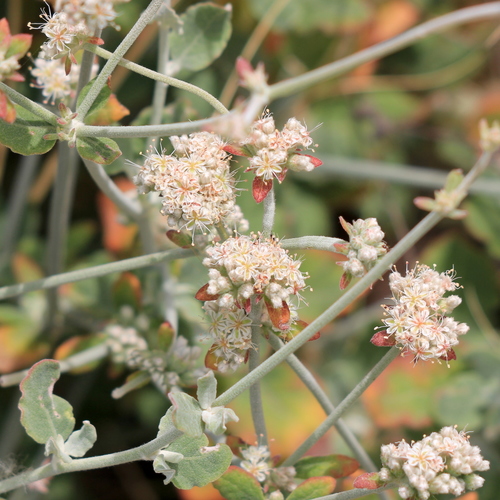
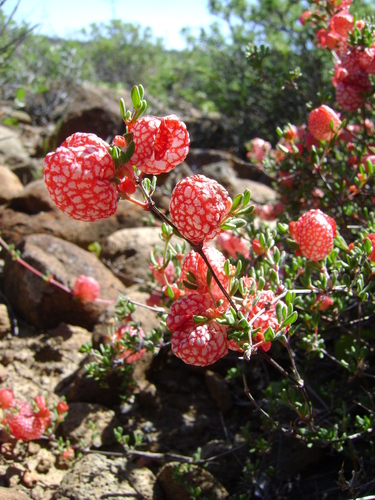
Harfordia macroptera is a sprawling to spreading shrub or subshrub, most recognizable by its conspicuous, colorful sac-like bracts that help disperse its achenes. Plants may be monoecious, but are more commonly dioecious, and are often not easily noticeable in their habitat until their inflated bracts are fully expanded. This species grows numerous slender to stout stems from a woody taproot. Its leaves are cauline and opposite, with leaf blades ranging from linear to oblanceolate to obovate-spatulate in shape. Leaves can be either glabrous or pubescent with slightly curled hairs, and are thin to somewhat thick and more or less succulent. Inflorescences bear flowers in axillary clusters, or on perfect or female plants, grow on short, stout peduncles. These peduncles measure 0.7 to 2 cm long, and are usually densely pubescent. Male plants lack involucres, while in perfect or female plants the involucre is reduced to a highly modified, sac or bladder-like bract. This modified bract enlarges as the flower develops, it is hyaline in color with deep red to red-purple veins, and is hairless. Flowers are either imperfect or perfect, with 6 monomorphic, lanceolate tepals. Male flowers are pale yellow, smaller than female flowers, and occasionally have an aborted ovary. Female flowers are pale yellow when young, then turn red to rose as they mature, and always have aborted stamens. Perfect flowers are pale yellow to rose. There are 9 stamens total: male flowers have stamens that slightly protrude on elongated filaments that bear yellow oval anthers, while female flowers have stamens on minute filaments that bear small aborted anthers. The fruit is a 3 to 5 mm long achene, colored yellowish-brown to brown. The characteristic bladder-like bract that surrounds the achene begins as a tiny immature bract subtending the pedicel. When young, the bract is reflexed and made of three individual segments that only join at their attachment point. As the bract matures, it enlarges and forms a sheath around the pedicel. Once the flower inside is fertilized, the bract rapidly expands upward and outward, eventually completely overtopping and enclosing the achene. The two laminar sides of the bract continue expanding to form the conspicuous bladder-like portion of the structure. The modified bract is hypothesized to aid achene dispersal: the inflated, papery bract detaches easily and is blown by wind, carrying the enclosed achene and allowing it to be readily transported. While the bract does dry out, its network of veins prevents it from simply disintegrating. Even after detachment, rain can re-inflate the bract, which can then be moved again by wind from thunderstorms. Achenes can remain attached to their bracts for up to two to three years.