About Haploblepharus pictus (Müller & Henle, 1838)
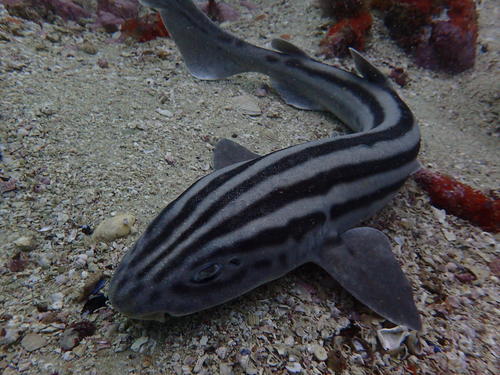
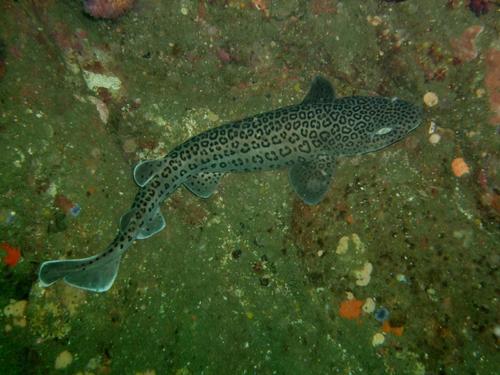
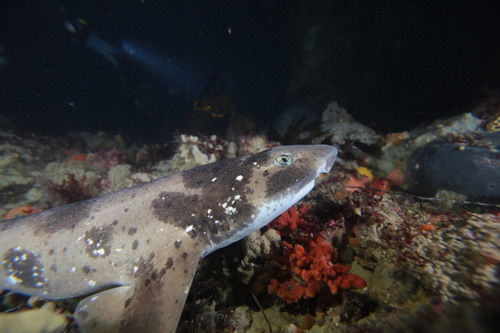
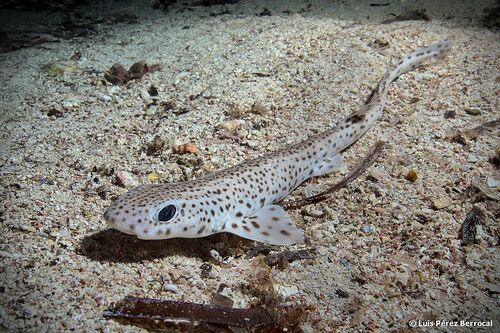
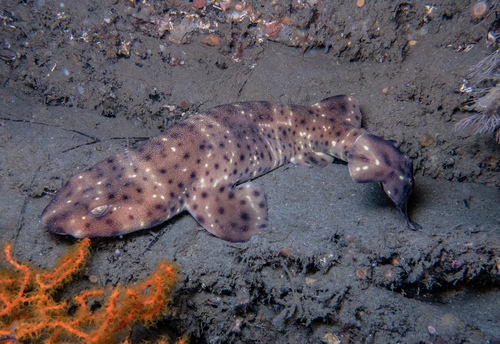
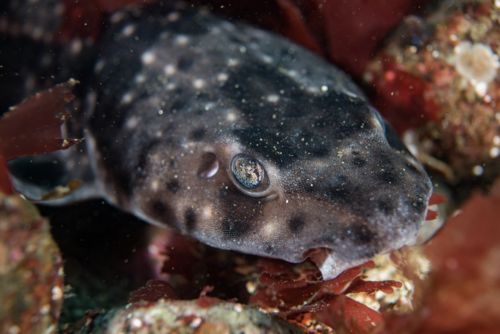
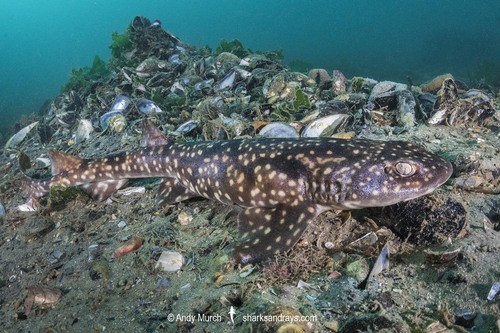
The dark shyshark, scientific name Haploblepharus pictus (Müller & Henle, 1838), grows to a maximum length of 60 cm (24 in). This species differs from other shysharks in body shape: it has a slender body as a juvenile, and a stocky body as an adult. Its head is short, wide, and flattened, with a bluntly rounded snout and very large nostrils. The anterior rims of the nostrils hold greatly enlarged skin lobes, which are fused into a single flap that extends to the mouth. This flap covers the nasal excurrent openings and a pair of grooves that run between these openings and the mouth. The large, horizontally oval eyes have rudimentary protective third eyelids called nictitating membranes, and prominent ridges sit beneath the eyes. The mouth is short but wide, with furrows at the corners that extend onto both jaws. There are 45–83 tooth rows in the upper jaw and 47–75 tooth rows in the lower jaw; each tooth has a long central cusp flanked by two smaller cusplets. The five pairs of gill slits are positioned fairly high on the body. The two dorsal fins are nearly equal in size and placed far back on the body: the first originates over the last third of the pelvic fin bases, and the second originates over the last half of the anal fin base. The pectoral and pelvic fins are broad and rounded, and mature males have stout claspers. The pelvic and anal fins are roughly the same size as the dorsal fins. The broad caudal fin makes up about one-fifth of the shark’s total body length, with a prominent notch near the tip of the upper lobe and an indistinct lower lobe. The shark’s skin is thick and covered in well-calcified, arrowhead-shaped dermal denticles. Dark shyshark coloration is highly variable, and individual sharks can resemble any other shyshark species. The dorsal background color ranges from light brown to reddish to grayish to almost black, and transitions abruptly to white or cream on the underside. Sometimes dark blotches appear beneath the paired fins. 6 to 8 variably shaped orange, brown, or blackish saddles run along the back and tail, with more or less distinct black edges. White spots may also be present within the saddles, or within and between the saddles. The dark shyshark’s range is limited to the coastal waters of southern Africa, extending from north of Lüderitz in southern Namibia to east of the Storms River mouth in South Africa’s Eastern Cape Province. It is abundant, especially in areas west of Cape Agulhas. This bottom-dwelling species lives close inshore, from the intertidal zone down to a depth of 35 m (115 ft). It prefers rocky reefs and kelp forests, but is assumed to cross sandy flats between patches of more suitable habitat. Since this shark is not known to travel long distances, subpopulation differentiation likely occurs across parts of its range. The dark shyshark is a generalist predator. By importance, its main food sources are small benthic crustaceans, bony fishes, and molluscs. Larger sharks eat a proportionally larger amount of crustaceans. It also occasionally feeds on polychaete worms and echinoderms, and algae may be swallowed accidentally. This species is preyed on by the broadnose sevengill shark (Notorynchus cepedianus), and may also be hunted by other large fishes and marine mammals. When threatened, the dark shyshark uses a characteristic defensive behavior: it curls into a ring, covering its eyes with its tail. This posture likely makes the shark harder to swallow, and is the origin of the common names "shyshark" and "doughnut". In captivity, the whelks Burnupena papyracea and B. lagenaria have been observed piercing the egg cases of this shark and removing the yolk. A known parasite of the dark shyshark is the blood-infecting trypanosome Trypanosoma haploblephari. Like other members of its genus, the dark shyshark is oviparous. Adult females have one functional ovary and two functional oviducts. There is no distinct breeding season, and reproduction takes place year-round. Females produce two mature eggs at a time, one per oviduct. The eggs are enclosed in purse-shaped capsules that measure 5.5 cm (2.2 in) long and 2.5 cm (0.98 in) across. Each capsule is plain amber to dark brown, and has thin, coiled tendrils at all four corners. In one recorded observation, an egg hatched after 104 days; the developing embryo had external gill filaments until it was 50 days old, and fully absorbed its yolk sac shortly before hatching. In natural conditions, eggs usually hatch after 6 to 10 months, and newly hatched sharks measure 10–12 cm (3.9–4.7 in) long. Both sexes grow at roughly the same rate, and reach sexual maturity around 15 years of age. Mature males are 40–57 cm (16–22 in) long, while mature females are 36–60 cm (14–24 in) long. The maximum recorded lifespan of the dark shyshark is 25 years.