About Haploblepharus fuscus Smith, 1950
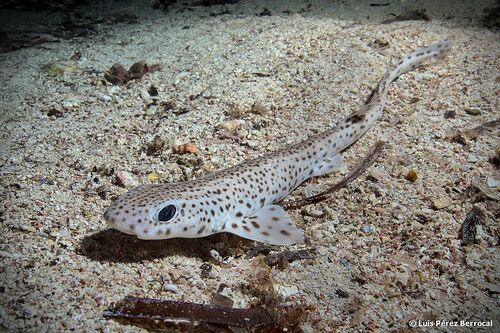
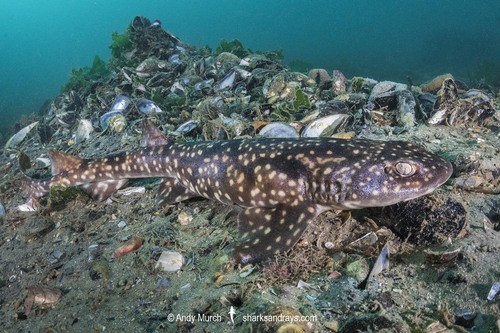
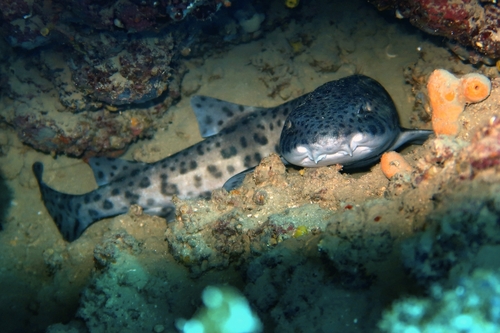
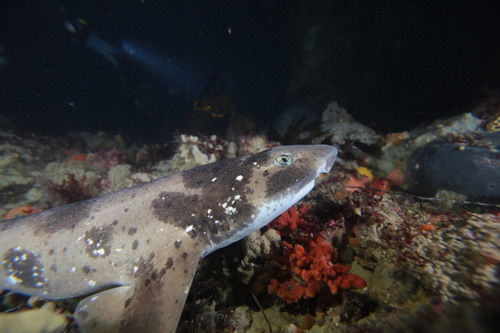
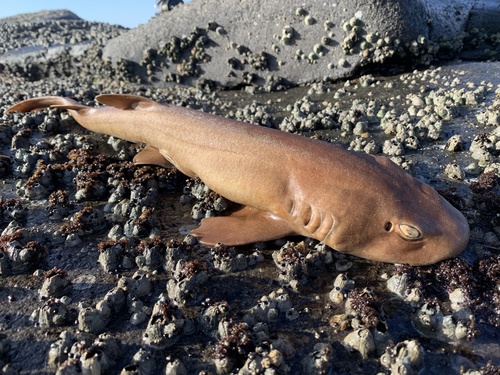
Haploblepharus fuscus Smith, 1950, commonly called the dark or brown shyshark, is a small shark species that reaches a maximum known length of 73 cm (29 in). It has a stocky body and a short, broad head, with a blunt, dorsally flattened snout. Its eyes are large and oval, with a rudimentary nictitating membrane (a protective third eyelid) and a strong ridge underneath. The nostrils are very large, flanked by greatly expanded, triangular skin flaps that extend to the mouth; these nasal flaps cover a pair of deep grooves that connect the nasal outflow openings to the mouth. There are furrows at the mouth corners on both jaws. Each tooth has a central cusp plus a pair of smaller cusplets on the sides. It has five pairs of gill slits located on the upper sides of its body. The first dorsal fin originates well behind the origins of the pelvic fins, and the second dorsal fin originates behind the origin of the anal fin. Its pectoral fins are moderately large, while the dorsal, pelvic, and anal fins are similar in size. The caudal fin is short and broad, with a notch near the tip of the upper lobe and an indistinct lower lobe. Its thick skin is covered by well-calcified, leaf-like dermal denticles. Its dorsal coloration is plain brown and its ventral coloration is white, though some individuals have faint darker saddle-like markings or black or white spots. This shyshark has a restricted distribution along the coast of South Africa, ranging from the Western and Eastern Cape Provinces to southern KwaZulu-Natal Province. It is typically found close to the sea floor over sandy flats or rocky reefs, from the intertidal zone down to a depth of 35 m (115 ft), though it has been recorded at depths as great as 133 m (436 ft). Its range overlaps with the puffadder shyshark in the southeastern Cape region; in this area, the brown shyshark tends to prefer shallow inshore habitats, while the puffadder shyshark lives in deeper offshore waters. The brown shyshark is a sedentary, bottom-dwelling species; one tag-recapture study found that recaptured individuals had moved no more than 8 km (5.0 mi) from their original tagging location. It feeds on bony fishes and lobsters. Like other members of its genus, this shark curls into a ring with its tail covering its eyes when threatened, which gives it the common name "shyshark". It is oviparous; females deposit egg capsules (called "mermaid's purses") two at a time. In captive settings, the whelks Burnupena papyracea and B. lagenaria have been recorded piercing the shark's egg cases to extract the yolk. Males reach sexual maturity at 68–69 cm (27–27 in) in length, and females reach sexual maturity at 60–61 cm (24–24 in) in length.