About Haploblepharus edwardsii (Schinz, 1822)
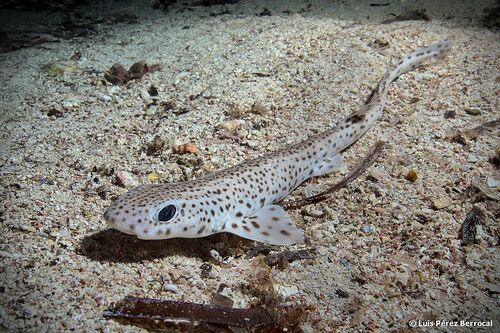
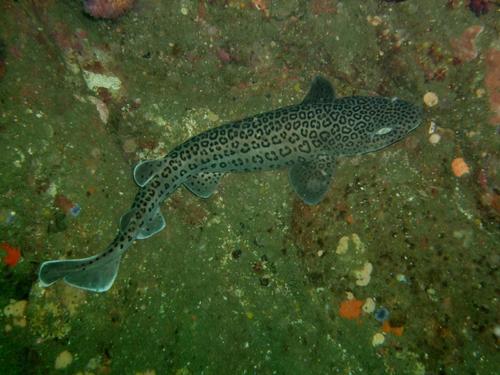
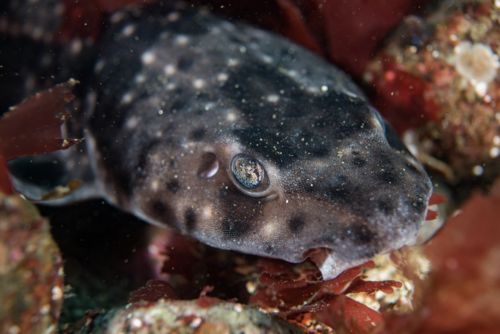
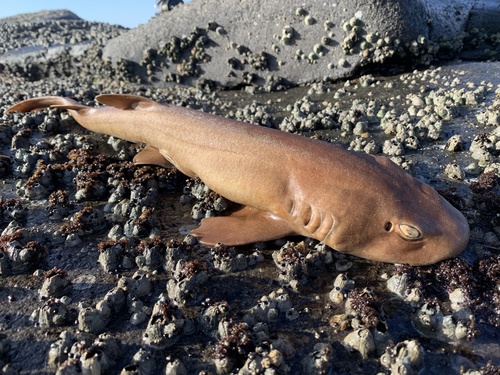
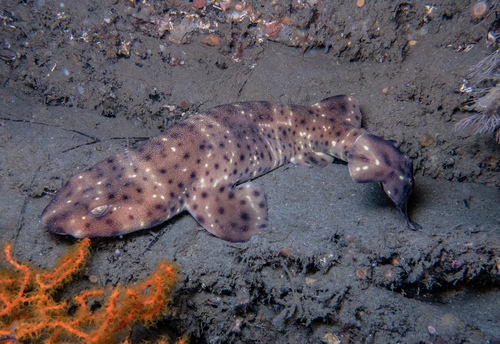
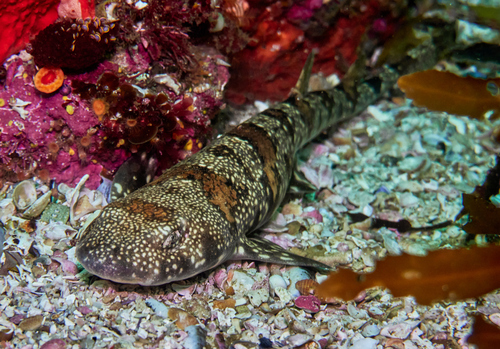
The puffadder shyshark, scientifically named Haploblepharus edwardsii (Schinz, 1822), is more slender than other shyshark species. It has a short, broad, dorsally flattened head and a narrowly rounded snout. Its large, oval-shaped eyes have cat-like slit pupils, a simple protective nictitating membrane (third eyelid), and a prominent ridge underneath the eyes. The nostrils are very large, with a pair of greatly expanded, triangular fused skin flaps in front that reach the mouth. A deep groove connects each nostril's outflow opening to the mouth, and this groove is hidden by the nasal flaps. The shark's mouth is short, with furrows at the corners of both jaws. It has 26–30 tooth rows in the upper jaw, and 27–33 tooth rows in the lower jaw. Tooth shape is sexually dimorphic: male teeth are longer and three-pointed, while female teeth are shorter and five-pointed. Unusually, the two halves of the lower jaw are connected by a special cartilage, which allows more even distribution of teeth and may increase bite strength. The shark's five pairs of gill slits are positioned somewhat on the upper surface of its body. The dorsal, pelvic, and anal fins are all of similar size. The dorsal fins are located far back on the body: the first dorsal fin originates behind the origins of the pelvic fins, and the second originates behind the origin of the anal fin. The pectoral fins are broad and moderately sized. The short, broad caudal fin makes up about one-fifth of the shark's total body length; it has a deep ventral notch near the tip of the upper lobe, and a barely developed lower lobe. The shark's skin is thick and covered by well-calcified, leaf-shaped dermal denticles. Its dorsal coloration is a light to dark brown background marked with 8–10 distinct yellowish to reddish brown "saddles" that have darker margins, and the entire dorsal surface is covered by a profusion of small white spots. The underside of the shark is white. This species reaches a typical length of 60 cm (24 in), with a maximum recorded length of 69 cm (27 in). Individuals found west of Cape Agulhas are smaller than those found east of the location, reaching only 48 cm (19 in) long. The puffadder shyshark's range is restricted to the continental shelf off the coast of South Africa, extending from Langebaan Lagoon in Western Cape Province to the western shore of Algoa Bay. Older records of the species occurring as far north as Durban are now believed to be misidentifications of other shark species. This bottom-dwelling shark is most common over sandy or rocky seabeds. It is found in progressively deeper water toward the northeastern part of its range: it occurs from 0–15 m (0–49 ft) deep off Cape Town, and from 40–130 m (130–430 ft) deep off KwaZulu-Natal. This distribution pattern may reflect the shark's preference for cooler waters. Quite common within its limited range, the puffadder shyshark is sluggish and reclusive, and is often found lying motionless on the sea floor. It is gregarious, and multiple individuals may rest together. It is a generalist predator with grasping dentition, and hunts a variety of small benthic prey: crustaceans (including crabs, shrimp, crayfish, mantis shrimp, and hermit crabs), annelid worms (including polychaetes), bony fishes (including anchovies, jack mackerels, and gobies), cephalopods (including squid), and fish offal. Overall, crustaceans are the most important component of the shark's diet, followed by polychaetes, then fishes. Males appear to prefer polychaetes, while females prefer crustaceans. The species has been observed attacking the common octopus (Octopus vulgaris) by tearing off an arm with a twisting motion. Larger fishes, such as the broadnose sevengill shark (Notorynchus cepedianus), prey on the puffadder shyshark. The Cape fur seal (Arctocephalus pusillus pusillus) has been recorded capturing and playing with puffadder shysharks, tossing them into the air or gnawing on them. The shark is often injured or killed during these encounters; the seal may eat torn pieces of flesh, but rarely consumes the entire shark. Occasionally, black-backed kelp gulls (Larus dominicanus vetula) take advantage of this seal behavior and steal the sharks from the seals. When threatened or disturbed, the puffadder shyshark displays a characteristic posture: it curls into a ring and covers its eyes with its tail. This reaction is the origin of the common names "shyshark" and "doughnut", and it likely makes the shark harder for a predator to swallow. Whelks of the species Burnupena papyracea and B. lagenaria feed on the puffadder shyshark's eggs, at least in captive settings. Documented parasites of this species include the blood-infesting trypanosome Trypanosoma haploblephari, the intestine-infesting nematode Proleptus obtusus, and the skin-infesting copepods Charopinus dalmanni and Perissopus oblongatus. Another parasite is the praniza larval stage of the isopod Gnathia pantherina, which infests the nares, mouth, and gills. The deep-penetrating mouthparts of these larvae cause significant damage to local tissue, leading to bleeding and inflammation.