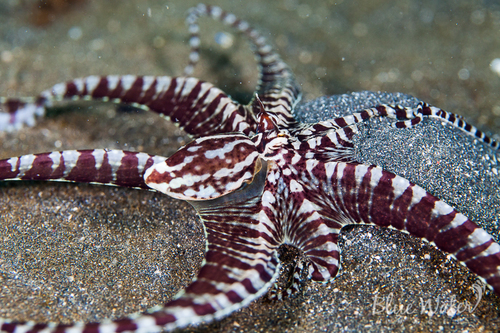
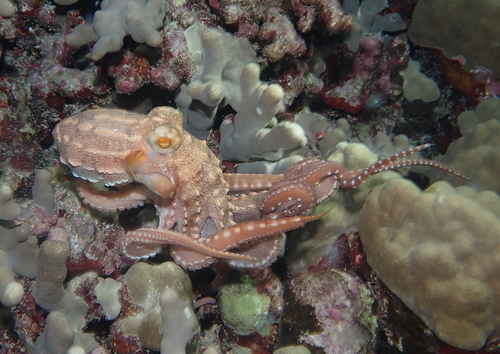
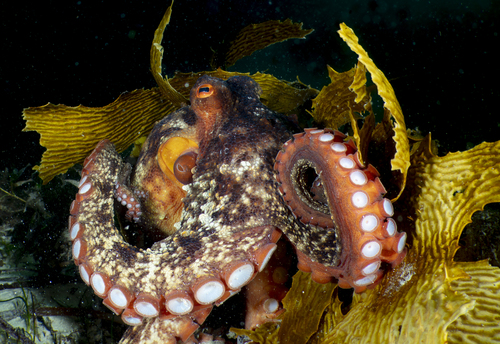
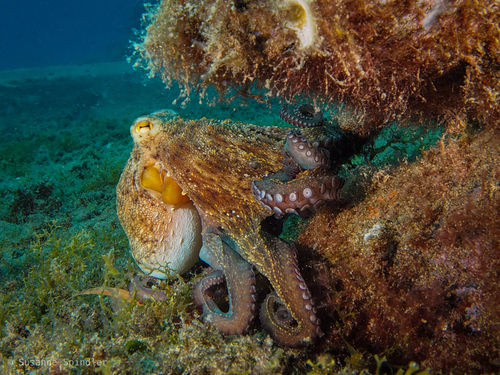
About Hapalochlaena maculosa (Hoyle, 1883)
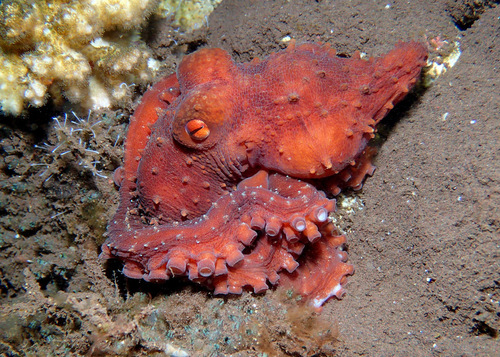
Hapalochlaena maculosa, commonly called the southern blue-ringed octopus, is the largest species in the blue-ringed octopus genus, and is classified as a distinct species for this reason. Measured from arm tip to opposite arm tip, most individuals do not grow larger than 20 centimeters, which is roughly 5 centimeters larger on average than other blue-ringed octopus varieties. When the octopus is calm, its base coloration is typically a dull, mucus-like tone. However, when it feels sufficiently threatened, the species' namesake blue rings suddenly appear on its body. On average, these octopuses have around 60 rings that possess multilayer reflectors, which allow the rings to flash a blue-green color. These characteristic rings typically appear approximately 6 weeks after the octopus hatches, per research by Mäthger et al. To make the rings light up and glow, the muscles surrounding each ring must contract, while the muscles positioned above the rings must relax (Mäthger et al.). This specific method of muscle control to produce illumination has not been observed in other luminescent animals, according to Mäthger et al. Hapalochlaena maculosa is found along the southern coasts of Australia. It lives in crevices and cracks in the rocky reefs that are common to this stretch of Australian coast, and often resides near abundant seagrass forests. This species has a very short lifespan, with reproduction playing a major role in its life cycle. The average lifespan of a southern blue-ringed octopus is around seven months. The species reaches sexual maturity at approximately four months old, and individuals spend their remaining few months focused on mating and breeding. Both males and females are promiscuous, as each individual only produces a limited number of gametes. Mating in H. maculosa usually begins when the female initiates reproduction by changing her color and posture. The male then mounts the female, inserts his hectocotylus under the female's mantle, and releases sperm into the female's oviduct. Females have an approximately two-month window during which they can acquire and store sperm from multiple males. After this period, females carry their eggs with them, rather than attaching and leaving them in a fixed location. During egg carriage, the mother rarely moves unless disturbed. If she is forced to move, she uses only two arms for locomotion. The female also does not eat throughout this entire period. As a result of this fasting, the mother dies shortly after her eggs hatch. It is very unlikely that either a male or female H. maculosa lives longer than one year. This unusual maternal care system is considered an advanced evolutionary adaptation in this species. This strategy works because females only reproduce once in their lifetime, so the survival of their egg clutch is critical. After hatching, H. maculosa grow very quickly. The southern blue-ringed octopus differs from many other marine invertebrates in that it has no planktonic larval stage. Young octopuses begin hunting at around one month of age. They are venomous from the moment they hatch, though their characteristic blue rings do not appear until six weeks after hatching. A study by Morse and Zenger found that as an octopus increases in size, its willingness to mate also increases. Same-sex mating attempts are frequently observed in this species, which suggests that distinguishing between males and females is difficult even for the octopuses themselves. It is also possible that females use some form of refined sense of smell to identify particularly attractive mates.