About Hapalochlaena lunulata (Quoy & Gaimard, 1832)
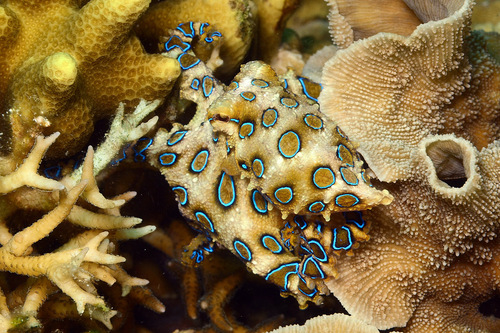
The greater blue-ringed octopus, Hapalochlaena lunulata, is a small octopus despite its common name. Its total maximum size including arms does not exceed 10 centimetres (3.9 in), and it has an average weight of 80 grams (2.8 oz). Its common name comes from its relatively large blue rings, which measure 7 to 8 millimetres (0.28 to 0.31 in) in diameter; these rings are larger than those of other members of the Hapalochlaena genus, and help distinguish this species. This octopus has a head that is slightly flattened dorsoventrally (front to back) and ends in a tip. Its eight arms are relatively short. The mantle of Hapalochlaena lunulata has variable ring patterns, and its overall coloration changes to match its surrounding environment, ranging from yellow ocher to light brown, and even whitish when the octopus is inactive. There are around 60 blue rings total, spread across all of the octopus's skin. The rings are roughly circular, and are centered on a blotch that is darker than the surrounding skin background. Each bright electric blue circle is bordered by a black line of varying thickness, which increases the ring's contrast and visibility. These blue rings are an aposematic marking, which clearly signals to potential predators that this octopus is highly venomous. This species also has characteristic blue lines that run through its eyes. In studies of sex identification and mating behavior, the initiation of physical contact between octopuses is completely independent of sex, size, or residency status, and there are no notable sex-based differences in general behavior. However, spermatophores are only released during sexual interactions with females, and never during interactions with males, indicating that males can distinguish between sexes and decide whether to inseminate once copulation begins. Male-female copulation lasts roughly 160.5 minutes on average, while male-male mating interactions only last about 30 seconds. Studies have concluded that males cannot distinguish the sex of another octopus until copulation occurs, just before inserting the hectocotylus. The greater blue-ringed octopus is a solitary benthic animal, widespread across tropical and subtropical Indo-West Pacific waters, ranging from Sri Lanka to the Philippines, and from Australia to Papua New Guinea, the Solomon Islands, and Vanuatu. It prefers shallow waters with mixed seabed habitats, including rubble, reefs, and sandy areas. Like all octopuses, it lives in a burrow, and only leaves to search for food or a mate. The entrance to its shelter is scattered with leftover meal remains, such as empty shells and crab shells and legs, making the shelter easy to identify. Breeding season for this species varies depending on its geographical location. A female lays between 60 and 100 eggs, which she keeps under her arms during the roughly one-month incubation period. After hatching, newborns go through a short planktonic development stage before settling onto the seabed. The mating ritual begins when a male approaches a female and caresses her with his modified arm, the hectocotylus. Males then climb onto the female's back, sometimes completely covering the female's mantle and blocking her vision. The hectocotylus is inserted under the female's mantle, and spermatophores are released into the female's oviduct. Males die after mating. The female then lays between 50 and 100 eggs, and guards them by carrying them under her arm until they hatch around 50 days later, producing planktonic paralarvae. The female dies after hatching, as she stops eating while guarding her eggs. Newly hatched blue-ringed octopuses are about the size of a pea, and grow to reach the size of a golf ball when fully grown. They mature quickly, and begin mating the following autumn. Their average lifespan is about 2 years.