About Hapalochlaena fasciata (Hoyle, 1886)
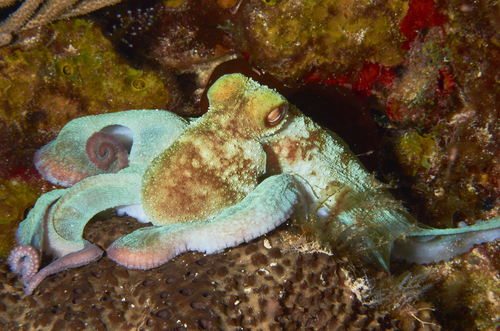
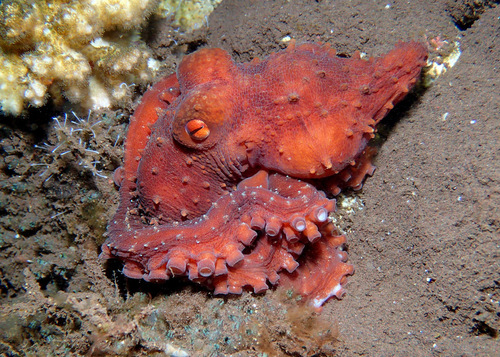
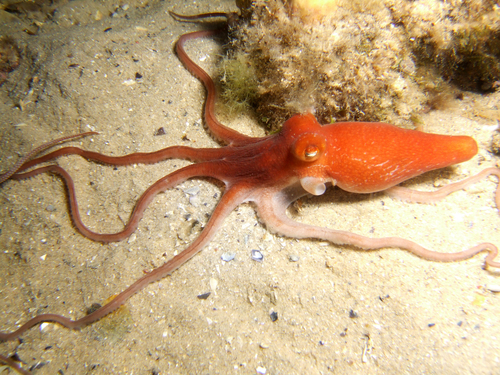
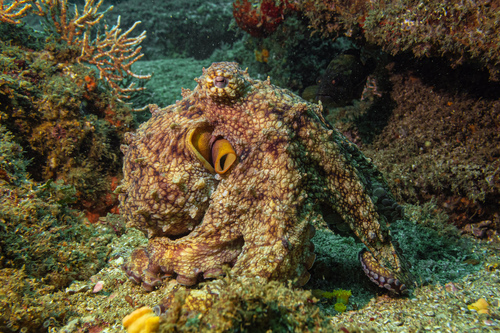
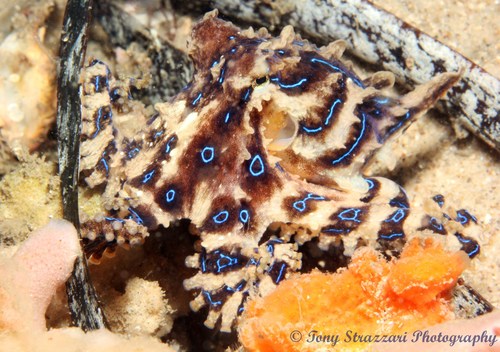
The blue-lined octopus, scientifically named Hapalochlaena fasciata, is one of four extremely venomous species of blue-ringed octopuses. It occurs in Pacific Ocean waters ranging from Australia to Japan. It is most common on intertidal rocky shores and in coastal waters down to 15 metres (49 ft) between southern Queensland and southern New South Wales, Australia. It is a relatively small species, with a mantle that reaches up to 45 millimetres (1.8 in) in length. When relaxed, its body is mottled yellow-brown, covered in dark blue or black streaks across the whole body except for the undersides of its arms; when it feels threatened, its vibrant blue markings appear as a warning to predators. Along with its close relatives, the blue-lined octopus is considered one of the most dangerous animals in the sea, and its venom can be fatal to humans. This is a benthic species, one of four members of the genus Hapalochlaena. The other three species are the greater blue-ringed octopus (Hapalochlaena lunulata), southern blue-ringed octopus (Hapalochlaena maculosa), and Hapalochlaena nierstraszi. The blue-lined octopus is the only one of the four species that has lined iridescent blue markings, while the three other species typically have circular iridescent blue markings. Blue-lined octopuses are commonly found off the coast of Australia, where they inhabit shallow tropical and subtropical reef waters. In recent years, they have been found throughout the Pacific Ocean, and have been recorded off the east coast of Japan, as well as off the coast of Jeju Island in Korea in 2015. This range shift suggests that warming ocean waters have shifted suitable habitat for these octopuses, and monitoring this shift is important to support public health and safety. Blue-lined octopuses reach reproductive maturity at one year old. During breeding, males seek out and mount females; unlike other octopus species, they do not extend the hectocotylus to mate from a distance. If mating is successful, the female lays 50 to 100 eggs 30 days after mating. Over the 30 days before hatching, the female keeps her eggs hidden under her arms and does not leave her hiding spot until the eggs hatch. After the eggs hatch, the female dies. The eggs are large and produce benthic hatchlings, which take approximately two months to complete development. Australian marine biologists have discovered that male blue-lined octopuses deliver a venomous bite directly to the female's heart during mating. The male approaches the larger female cautiously, often from behind, to lower the risk of triggering aggression. He bites her aorta, injecting tetrodotoxin (TTX). Within around 8 minutes, the female becomes paralyzed: her breathing slows, her body pales, her reflexes stop working, giving the male time and safety to mate. While the female is immobilized, the male uses his specialized hectocotylus arm to transfer spermatophores (sperm packets) into the female's mantle cavity.