About Handroanthus impetiginosum (Mart. ex DC.) Mattos
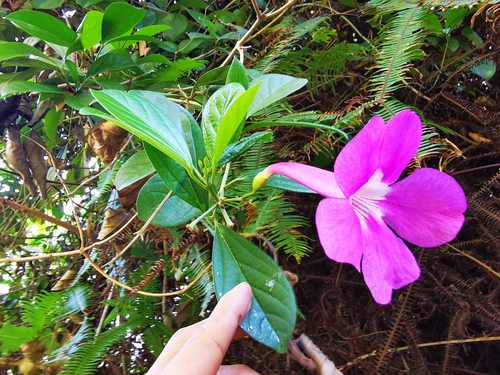
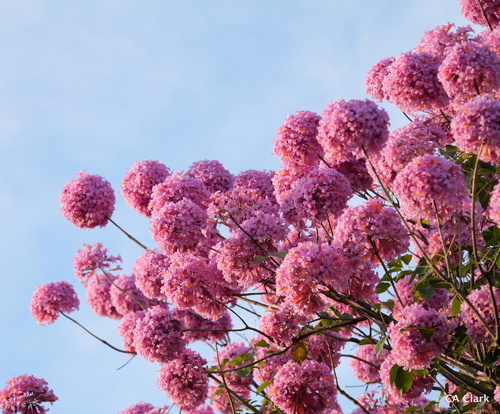
Handroanthus impetiginosum (Mart. ex DC.) Mattos is a large deciduous tree. Its trunk can sometimes reach 80 cm (31 in) in width and 30 m (98 ft) in total height; typically, one third of this total height is trunk, and two thirds are its extended branches. It has a large, globular but often sparse canopy, and grows at a slow rate. Its leaves are opposite, petiolate, 2 to 3 inches long, elliptic to lanceolate, with lightly serrated margins and pinnate venation; leaves are palmately compound, usually bearing 5 leaflets. The bark is brownish grey, tough, and hard to peel. The wood is a pleasant yellowish color, has few knots, and is very tough and heavy, with a density of 0.935 kg/dm³. It is rich in tannins, making it highly resistant to weather and sun exposure. It is not well-suited for furniture, as it is very difficult to work by hand, but it is used for outdoor beams and other outdoor structural applications. In the southern hemisphere, this species (commonly called pink lapacho) flowers between July and September, before new leaves emerge. Its flowers are large and tubular, with a corolla that is most often pink or magenta, and very occasionally white, measuring about 2 in (5.1 cm) long. Each flower has four stamens and one staminode. The fruit is a narrow dehiscent capsule that holds several winged seeds. The flowers are easily accessible to pollinators. Some hummingbirds, including the black jacobin (Florisuga fusca) and black-throated mango (Anthracothorax nigricollis), appear to prefer these flowers over the flowers of other Handroanthus species, and for the stripe-breasted starthroat (Heliomaster squamosus), pink lapacho flowers may even be a mainstay food source. Wild harvesting of Handroanthus impetiginosum for lumber (sold as ipê in most of the timber trade, for use in flooring and decking) has become a major driver of deforestation in the Amazon. Because these trees do not grow in dense concentrated stands, and instead grow scattered across the forest, long logging roads must be constructed over long distances to reach and harvest individual trees. In most cases, after these trees are logged, the remaining forest is cleared for agricultural use. Scientific analysis of current logging practices, which allow legal harvest of 90% of mature trees, found that recovery of harvested populations from juvenile growth is not likely within 60 years under any of the five feasible scenarios modeled. This situation parallels the overharvesting of Swietenia macrophylla (big-leaf mahogany), a species that grows in a similar geographic range in the same regions as ipê. Despite this parallel, ipê logging continues at very high rates, with no indication of it being listed by the Convention on International Trade in Endangered Species or that other drastic conservation actions (considered necessary to prevent extinction) will happen. Swietenia mahagoni and Swietenia humilis, other species harvested for mahogany wood, were so heavily depleted that by the early 1900s there were essentially no wild populations left to harvest. Unfortunately, Handroanthus impetiginosum is currently on track to experience a similar unsustainable depletion of its wild populations. This species is used as a honey plant, and is widely planted as an ornamental for landscaping in gardens, public squares, and boulevards, thanks to its striking, colorful floral display. Well-known and popular, it is the national tree of Paraguay. It is also planted as a street tree in Indian cities, including Bengaluru. The inner bark of Handroanthus impetiginosum is used in traditional medicine. It is dried, shredded, and boiled to make a bitter brown tea known as lapacho or taheebo. The unpleasant taste of this extract is milder when sold as pills or tinctures. Lapacho bark is typically used during flu and cold season to ease smoker’s cough. It is claimed to work by helping the lungs expectorate, and remove deeply embedded mucus and contaminants, within the first three to ten days of treatment. Lapacho holds an important role in the ethnomedicine of several South American indigenous groups. Over recent decades, herbalists have used it as a general tonic, immunostimulant, and adaptogen, and it is used in herbal medicine for intestinal candidiasis. However, the main active compound lapachol has been found to be toxic enough to kill fetuses in pregnant rats, and reduce the weight of the seminal vesicle in male rats at doses of 100 mg/kg of body weight. Lapachol does have strong antibiotic and disinfectant properties, and may be better suited for topical use. It also induces genetic damage, specifically clastogenic effects, in rats. The compound beta-lapachone has a direct cytotoxic effect and causes loss of telomerase activity in leukemia cells in vitro. Traditional ethnomedical use of lapacho and other Handroanthus teas is generally short-term, to clear acute health issues, rather than for use as a long-term general tonic. The usefulness of this plant as a short-term antimicrobial, disinfecting expectorant—for example, for PCP in AIDS patients—has not yet been studied scientifically. The inner bark of Handroanthus impetiginosum appears to have anti-Helicobacter pylori activity, and also has some effects on other human intestinal bacteria.