About Hamearis lucina (Linnaeus, 1758)
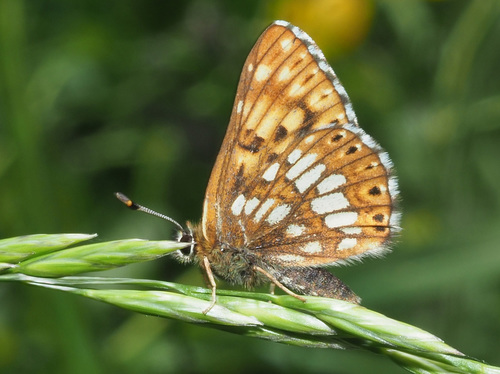
This species, Hamearis lucina (Linnaeus, 1758), commonly known as the Duke of Burgundy, has a different wingspan for males and females. Males have a wingspan of 29–31 millimetres (1.1–1.2 inches), while females have a wingspan of 31–34 mm (1.2–1.3 inches). The upperside of its wings has a chequered pattern that strongly resembles the pattern seen on fritillary butterflies in the family Nymphalidae, but the Duke of Burgundy can be distinguished from fritillaries by its wing shape. Hamearis lucina also has a unique, distinctive pattern on its underwings. The range of this species is limited to the Western Palaearctic, spanning from Spain, the United Kingdom, and Sweden in the west to the Balkans in the southeast. It is the only representative of its (sub)family found in Europe. In the United Kingdom, this species uses two distinct types of habitat: grassland growing on chalk or limestone, and clearings within ancient woodland. Colonies of Hamearis lucina prefer areas where the butterfly's food plants grow among tussocky vegetation. In downland habitats, the species specifically prefers slopes that face north or west.