About Hamamelis virginiana L.
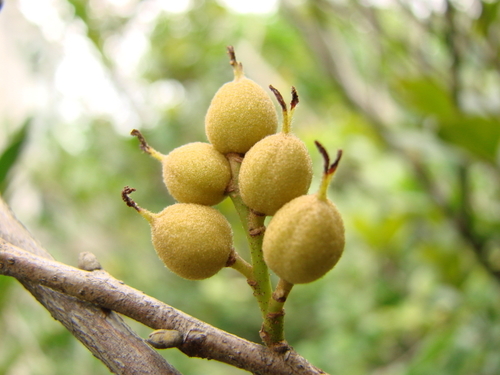
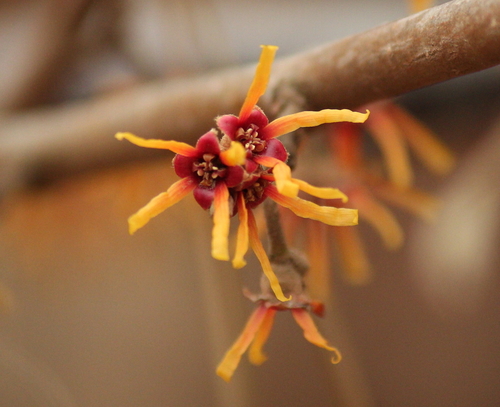
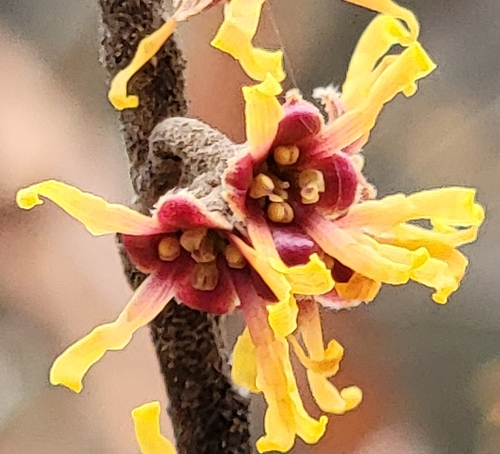
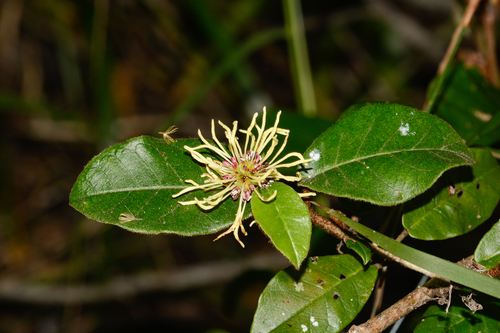
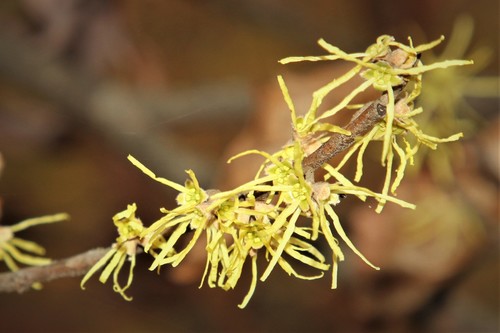
Hamamelis virginiana L. is most often a small deciduous tree or shrub, growing up to 6 metres (20 ft) tall, and rarely reaching 10 m (33 ft). It typically grows a dense cluster of stems from its base. The outer bark is light brown, smooth, and scaly, while the inner bark is reddish purple. Young branchlets are covered in fine hairs, becoming smooth and light orange brown with occasional white markings as they mature, eventually turning dark or reddish brown. Its foliage buds are pointed, slightly curved, downy, and light brown. The leaves are oval, measuring 3.7–16.7 cm (1+1⁄2–6+5⁄8 in) long and 2.5–13 cm (1–5+1⁄8 in) wide. They have an uneven oblique base, an acute or rounded tip, a wavy-toothed or shallowly lobed margin, and a short, thick petiole 6–15 mm (0.24–0.59 in) long. The stout midrib is more or less hairy, and bears six to seven pairs of primary veins. Young leaves emerge rolled inward, covered in rust-colored star-shaped down; when fully grown, they are dark green on the upper surface and paler underneath. In autumn, leaves turn yellow with rusty spots. The leaf stipules are lance-shaped and pointed, and fall off soon after the leaf fully expands. Flowers range from pale to bright yellow, and are rarely orange or reddish. They have four ribbon-shaped petals 1–2 cm (1⁄2–3⁄4 in) long, four short stamens, and grow in clusters. Flowering starts around mid-fall and continues through late fall. The floral calyx is overlapping in bud, deeply split into four parts, very downy, and orange brown on the inside. Two or three small bractlets grow at the base of the flower. The fruit is a hard woody capsule 10–14 mm (0.39–0.55 in) long. It splits explosively at the apex when it reaches maturity one year after pollination, ejecting the two shiny black seeds up to 10 m (33 ft) away from the parent plant. Hamamelis virginiana can be told apart from the related species Hamamelis vernalis by its fall flowering, rather than winter flowering. In terms of ecology, Hamamelis virginiana flowers from late September to late November, and occasionally flowers in December. After pollination, the ovary is protected by a persistent calyx and enters a resting state over winter. Ovary fertilization is delayed until the following spring, usually around mid-May, which is 5–7 months after pollination. Fruits develop through the growing season and reach maturity in late August. As the ripe fruit dries and splits open, seeds are ejected ballistically, usually by late October. The empty seed pod stays attached to the plant, sometimes for months. Seeds remain on the ground for two winters before germinating. Hamamelis virginiana is a pollinator plant that attracts moths and supports 62 species of caterpillars. For uses, Native Americans made witch hazel extract by boiling the shrub’s stems to create a decoction, which they used to treat swellings, inflammations, and tumors. Early Puritan settlers in New England adopted this remedy from Native Americans, and its use became widespread across the United States. An extract of this plant is used to make the astringent witch hazel. H. virginiana produces a specific group of tannins called hamamelitannins; one of these compounds shows specific cytotoxic activity against colon cancer cells. Native Americans used the bark and leaves to treat external inflammations. Pond's Extract was a well-known distillation of the bark in dilute alcohol. The wood is light reddish brown, with nearly white sapwood; it is heavy, hard, close-grained, and has a density of 0.68. Forked twigs of witch hazel are preferred for use as divining rods. The bark and leaves can be used to make tea to ease stomach issues, soothe sore throats, and more.