About Hamamelis mollis Oliv.
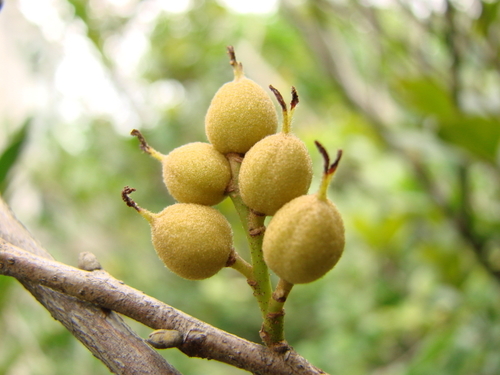
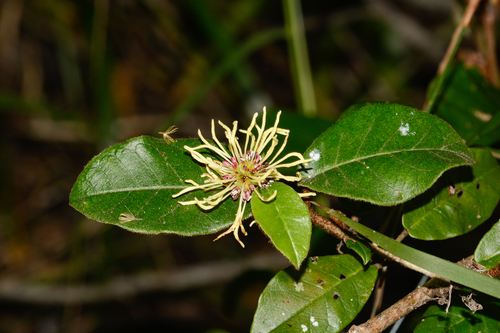
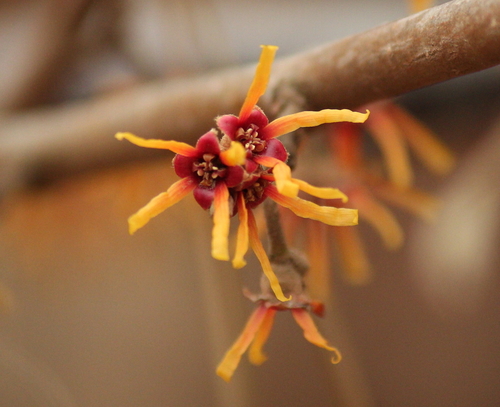
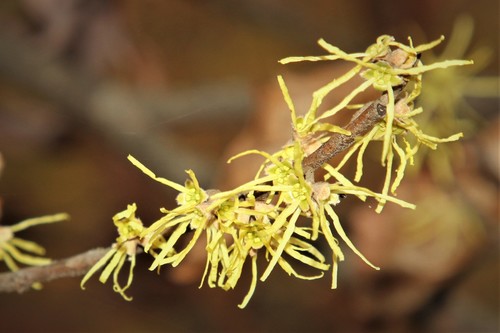
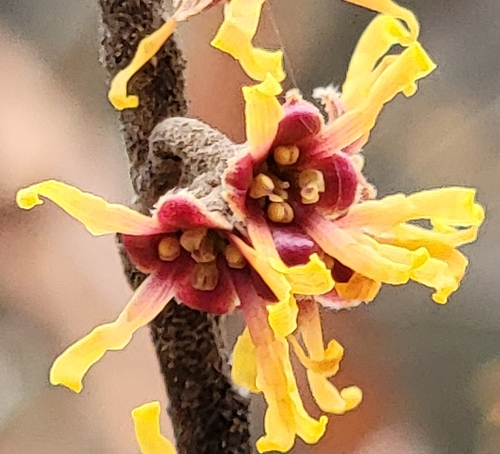
Hamamelis mollis, commonly called Chinese witch hazel, is a flowering plant species in the witch hazel family Hamamelidaceae. It is native to central and eastern China, specifically found in the provinces of Anhui, Guangxi, Hubei, Hunan, Jiangxi, Sichuan, and Zhejiang. It grows as a deciduous large shrub or small tree, reaching up to 8 meters (26 feet) in height. Its leaves are oval, measuring 8–15 cm long and 6–10 cm broad. The leaf base is oblique, while the leaf tip is either acute or rounded. Leaves have wavy-toothed or shallowly lobed margins, and a short petiole 6–10 mm long. The upper surface of mature leaves is dark green and thinly hairy, while the lower surface is covered in dense grey hairs that give it a grey appearance. The species epithet mollis is Latin for "soft", referring to the felt-like texture of its leaves. The leaves of this plant turn yellow in autumn. Its flowers are yellow, often with a red base, and grow in clusters. Each flower has four ribbon-shaped petals 15 mm (0.59 in) long and four short stamens. Flowering occurs from late winter to early spring, and blooms appear on bare, leafless branches. The fruit is a hard woody capsule 12 mm (0.47 in) long. At maturity, which occurs one year after pollination, the capsule splits explosively at its apex to eject two shiny black seeds away from the parent plant. Hamamelis mollis is widely cultivated as an ornamental plant. It is valued for its strongly scented winter flowers, which bloom when very few other plants are in growth. Numerous cultivars have been selected to vary in flower color, flower size, shrub size, and growth habit. This species is also one of the two parent species of the popular garden hybrid Hamamelis × intermedia; the other parent is Hamamelis japonica. Two cultivars of H. mollis, 'Jermyns Gold' and 'Wisley Supreme', have been awarded the Royal Horticultural Society's Award of Garden Merit.