About Hamadryas laodamia (Cramer, 1777)
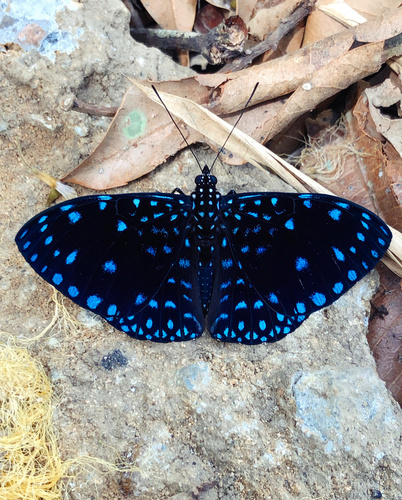
The species Hamadryas laodamia, commonly called the starry night cracker, is a black butterfly with iridescent blue speckling across its wings. Females have a broader white band on the underside of the forewing than males. This species has an approximate wingspan of 7 cm (2.8 in). Its caterpillars have short horns on their heads, whose function has not been identified, and its pupae are bright green. The starry night cracker is native to the Caribbean, Central America, and tropical South America. It can be found at altitudes up to 900 m (3,000 ft) on both the Pacific and Atlantic slopes of the Andes Ranges, but is most common in lowland forests of the Caribbean region, where it lives in the mid and upper parts of the forest canopy. The larvae of the starry night cracker feed on leaves of Dalechampia triphylla, a vine that belongs to the Euphorbiaceae family. This butterfly has aposematic colouring, and is avoided by jacamars — birds that feed on other camouflaged members of this butterfly family. It is believed that starry night cracker larvae accumulate distasteful toxic chemicals from their host plant leaves, and jacamars learn to avoid the brightly coloured adult butterflies. Adult starry night crackers do not visit flowers; instead, they get nutrients by sucking juice from rotting fruit. Just like their well-camouflaged close relatives, starry night crackers rest head-downward on tree trunks, holding their wings flattened against the bark.