About Haloragis erecta (Banks ex Murray) Eichler
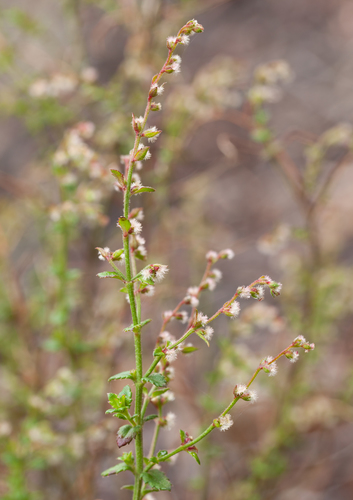
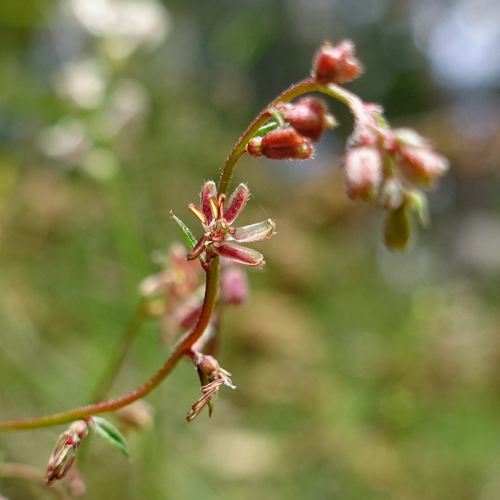
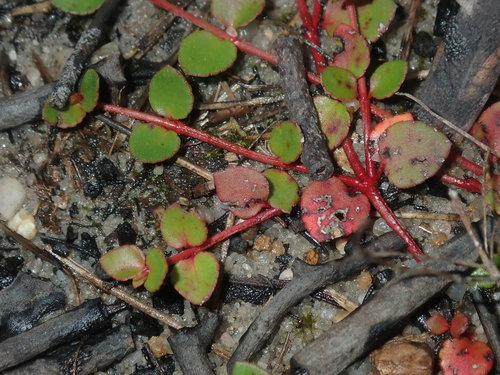
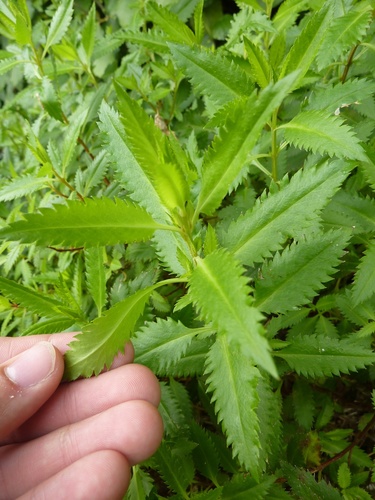
The toatoa (Haloragis erecta) produces openly branching stems that grow up to one metre tall, and the stems are easily recognizable by their red colour. It has an opposite leaf arrangement, small petioles, and leaves that reach up to 90 mm in length. Alongside its red stems, its most distinctive feature is leaf margins with serrations up to 4 mm long. Its leaves are elliptic in shape, with lateral veins running throughout the leaf blade. When flowering occurs from December to February, toatoa produces between 3 and 7 flowers per branch. These flowers range in colour from pinkish-red to vibrant yellow, with petals up to 10 mm long when the plant is fruiting. It produces small pinkish fruit that can reach up to 4 mm in diameter. Toatoa is found across New Zealand, growing from sea level up to an altitude of 500 m. It grows best in fertile soil, and forms colonies in areas that have experienced disturbance events such as land clearance, slip scars, and forest fires. It can self-propagate, which means it is occasionally seen as a weed in urban areas. Outside of New Zealand, it is found in the United States of America, French Polynesia, and the United Kingdom, having been introduced to these locations in the 1800s. Toatoa is a perennial plant, meaning it grows back year after year and follows an annual schedule of flowering and fruiting. Each year, the plant produces flowers that are pollinated by a variety of moths and butterflies. After pollination, it develops a small fruit that eventually falls from the plant and is dispersed by wind. Seeds lie dormant until the surrounding area is disturbed, or until there is insufficient vegetative cover above them; at this point, the seeds sprout and grow into new plants, continuing the cycle.