About Halobates micans Eschscholtz, 1822
As a member of the genus Halobates, Halobates micans spends its entire life in marine environments. It is one of just five Halobates species that live on the surface of the open ocean, and only occurs near coasts after being blown ashore by storms; the other four open-ocean Halobates species are H. germanus, H. sericeus, H. sobrinus, and H. splendens.
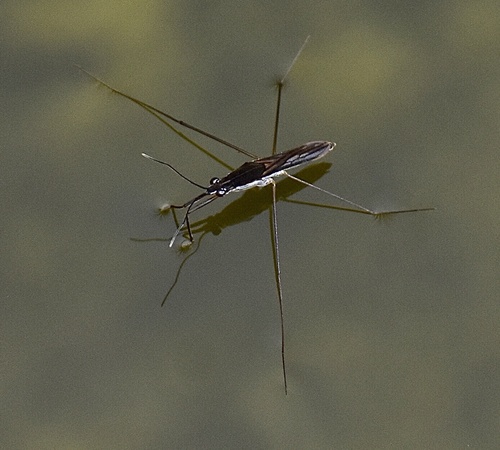
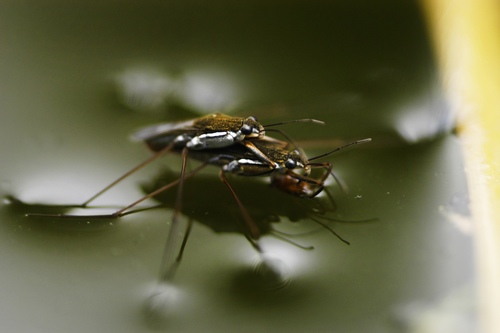
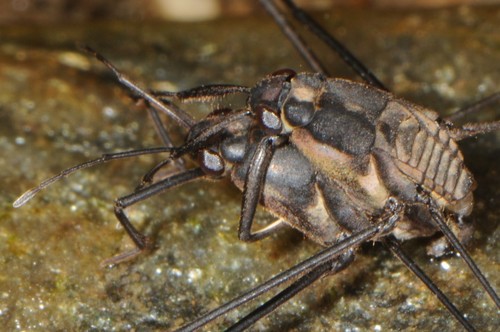
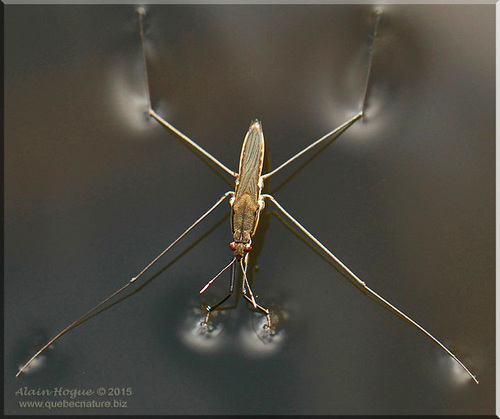
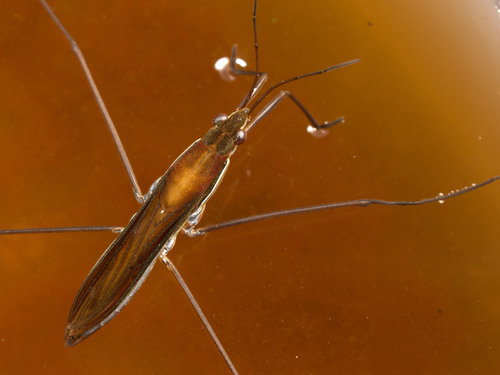
Adult Halobates micans have body lengths measured from head to abdomen of 3.6–4.5 mm (0.14–0.18 in), and males are larger than females. Their appendages extend beyond the total body length. Like all members of the genus Halobates, this species is wingless at every life stage, making it flightless, a trait it shares with some inland water striders.
H. micans has three pairs of legs that each serve distinct functions. The stout front pair grasps and holds prey during feeding. The middle pair is the longest, bears long hairs on the tibia and first tarsus, and provides most of the bug's propulsive force. The rear pair aids in steering. All three pairs of legs may also be used for grooming.
The body of Halobates micans has a characteristic silvery appearance, caused by light reflecting off an air layer trapped by very fine water-repellent hairs covering the body. Like all hemipterans, this species has sucking mouthparts, with cutting-specialized stylets that fit together to form a feeding tube. Halobates micans stores energy as lipid reserves; in other pelagic sea skater species, 92% of this lipid content may be triglyceride, a trait that may also hold for H. micans. Different Halobates species are hard to tell apart visually, but can be distinguished by closely comparing the length of their appendage segments and the genital segments of male individuals.
Very young H. micans nymphs are thought to feed exclusively on biofilm that grows on the ocean surface. Older nymphs and adult individuals are predators that feed on any organism they can capture at the open ocean surface, including zooplankton and floating insects, sucking out their prey's body fluids. Unlike nearshore Halobates species that avoid struggling prey, pelagic Halobates including H. micans prefer struggling prey. Cannibalism has been recorded in this species: older individuals only prey on younger individuals, and never on other mature members of the species. A small group of H. micans may share relatively large prey items.
Seabirds are the most significant predators of sea skaters overall, and remains of Halobates micans have been found in the digestive tracts of bridled terns (Sterna anaethetus). Specimens that have washed into coastal areas may be eaten by yellow warblers (Dendroica petechia), fish including the Pacific sardine (Sardinops sagax) and members of the mullet family Mugilidae, and the Galápagos lava lizard (Microlophus albemarlensis). Pelagic sea skaters, including H. micans, have been found to accumulate heavy metals in their bodies.
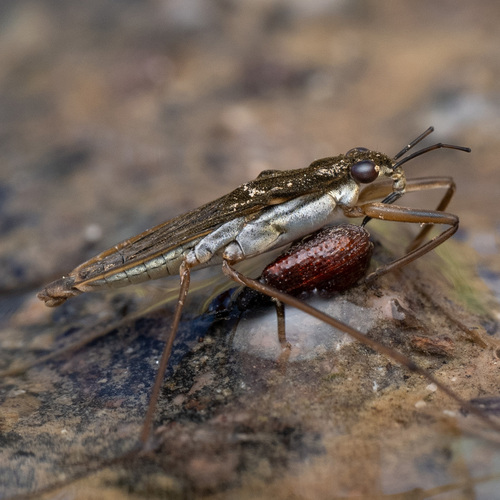
Halobates micans lays eggs 1 mm long on floating debris such as seabird feathers, driftwood, and plastic; eggs may even be laid on juvenile members of the species. Fresh eggs are olive in color, and turn orange after a few days. At 20 °C (68 °F), egg development can take up to one month. When ready to hatch, the nymph cuts through the egg chorion with a chitinized egg-burster, and completes emergence from the egg in approximately 3 minutes. Hatching occurs in staggered groups, which is likely an adaptation to reduce predation risk for newly emerged vulnerable nymphs.
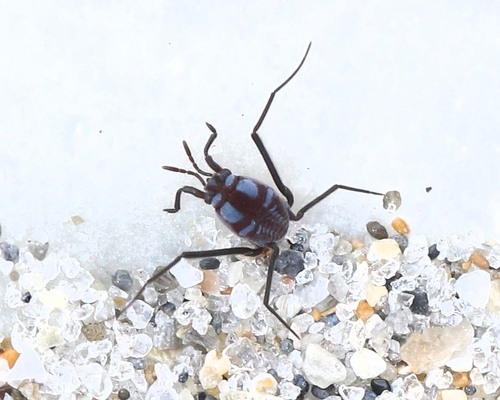
Newly hatched nymphs share the same general body shape as adults; first instar nymphs are pale brown rather than the dark grey of mature individuals. Nymphs reach sexual maturity after 5 moults, and it is impossible to distinguish the sex of immature individuals. A full generation from egg to mature adult is likely longer than two months. Individuals preparing to moult become sluggish and stop feeding, and newly moulted teneral nymphs are pale yellow to off-white. The speed of H. micans development is thought to depend on surrounding water temperature.