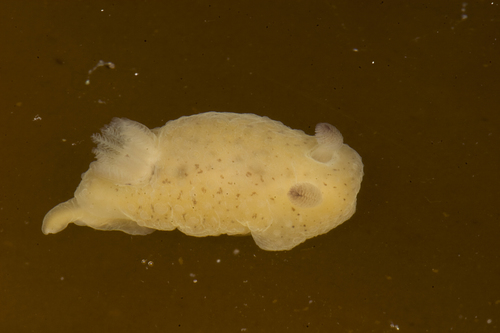
About Hallaxa chani Gosliner & G.C.Williams, 1975
Hallaxa chani preys exclusively on Halisarca sp., a slick-textured dendroceratid sponge that lacks both spicules and spongin fibers, as documented by Goddard in 1981, 1984, and 1998. Like other species in the Hallaxa genus, Hallaxa chani is remarkably cryptic when on its prey, matching it in both color and texture. Both the nudibranch and its sponge prey are tan to yellow-tan, and Hallaxa chani itself also lacks spicules. Furthermore, the mantle edge of Hallaxa chani is semi-translucent, and blends almost seamlessly when the nudibranch spreads it over the surface of Halisarca sp. The radular teeth of Hallaxa chani are similar in shape to those of other nudibranchs that primarily prey on spicule-free sponges. This similarity provided an early clue that Hallaxa chani does not feed on colonial ascidians, as was originally reported by McDonald & Nybakken in 1978, per Goddard 1981. As noted by Nybakken & McDonald (1981), nudibranchs that specialize on ascidians or fleshy ctenostome bryozoans have a radula dominated by large, paired, wing-shaped lateral teeth. Dorids that specialize on dendroceratid and dictyoceratid sponges have thin, comb-like outer lateral teeth with multiple denticles, as documented by Goddard 1981 (personal observations), Rudman 1984, and seen in electron micrographs of radulae published in Gosliner & Johnson 1994. Hallaxa chani's distribution ranges from central California to southeast Alaska, according to Gosliner & Williams 1975 and Millen 1989. It is rare in the southern portion of its range, but in the Pacific Northwest, it can be quite common in boulder and cobble habitats that support large populations of its sponge prey, Halisarca sp., as noted by Goddard 1981, 1984, and Goddard et al. 1997. Most records of Hallaxa chani come from the intertidal zone, but Millen (1983 and 1989) found the species subtidally at unspecified depths in British Columbia and Alaska.

