About Haliotis spadicea Donovan, 1808
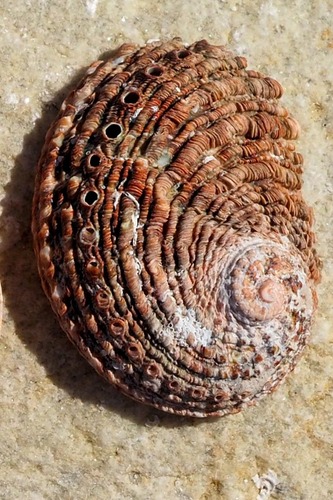
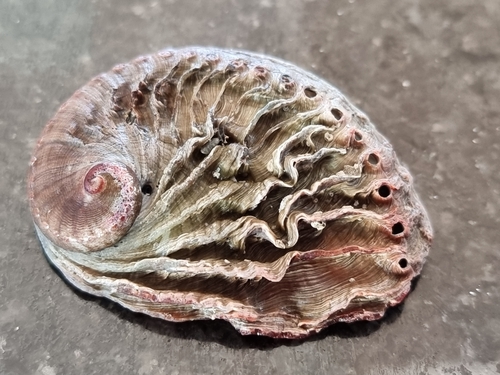
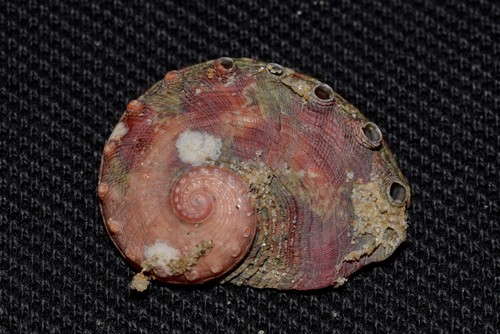
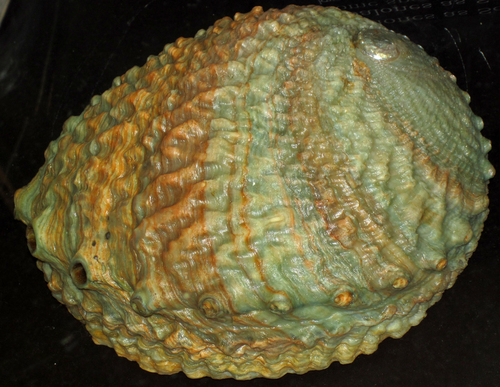
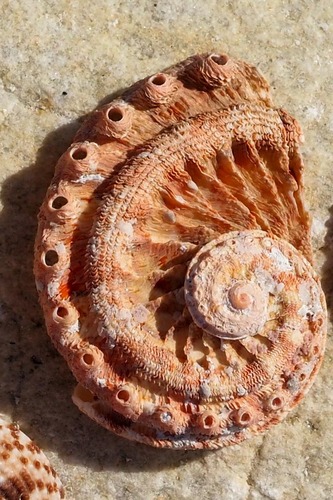
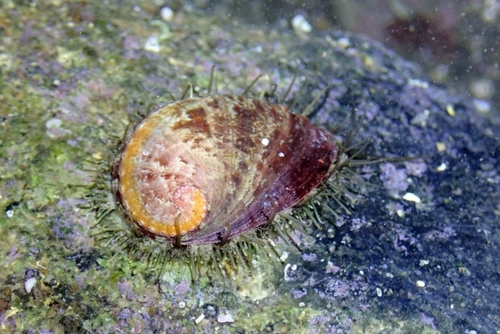
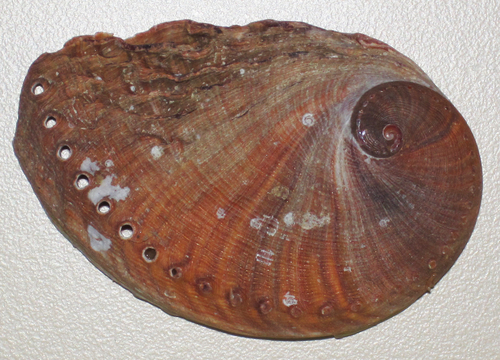
Haliotis spadicea Donovan, 1808 is an abalone species with the following shell characteristics. The exterior shell color is reddish-purple, often marked with white blotches. Between 5 and 8 open respiratory pores run along the shell margin; these holes together form the selenizone, which develops as the shell grows. Adult shells reach approximately 70 millimetres (2.8 in) in length. The shell is depressed and oblong-ovate in shape, narrowing toward the anterior end. The ratio of the distance from the apex to the margin, relative to the total shell length, is 1 to 7 or 8. When visible, spiral striae are very indistinct, and the shell surface bears coarse, oblique radiating folds. The left margin is consistently arcuate, while the right margin is straightened, with slight concavity along the middle section of the outer lip. The shell is solid yet rather thin, with a dark reddish-brown base color variegated by snowy white blotches, especially in young individuals. The spire often has a distinct bronze red color. The shell surface has a small number of impressed spiral striae that are often barely visible, along with low, very irregular undulations or radiating folds that are also often nearly worn away. Adult shells do not have a strong carina at the location of the row of perforations. Several rather strong cords run parallel to the perforations, between the perforations and the columellar margin. The low spire is made up of approximately three whorls. The inner shell surface is brilliantly pearly. The columellar plate is narrow, with a rounded, convex edge that slopes outward and is obliquely truncated at the lower end. The cavity of the spire is visible from below; it is rather deep, and usually has a beautiful red-bronze color on its inner surface. The most distinguishing features of this species are its distinct shape, narrowed at the anterior end, its reddish or chocolate-colored surface that is smooth aside from radiating folds, and the coppery red color inside the spire cavity. This last feature is sometimes absent. The perforations are numerous, closely spaced, and almost perfectly circular. The columellar plate (or shelf) slopes outward, is rather narrow, and convex on its surface. When the shell is placed on a flat surface, it rests on its two extremities, with both lips arched. The apex sits closer to the margin than that of Haliotis midae, another Cape abalone species that shares with H. spadicea the trait of lacking distinct spiral striation. This species is distributed in the Indian Ocean off the coast of South Africa. The meat of this abalone is edible, and was historically consumed by people living along the South African coast, though commercial and recreational abalone fishing is now banned in South Africa.