About Haliotis rubra Leach, 1814
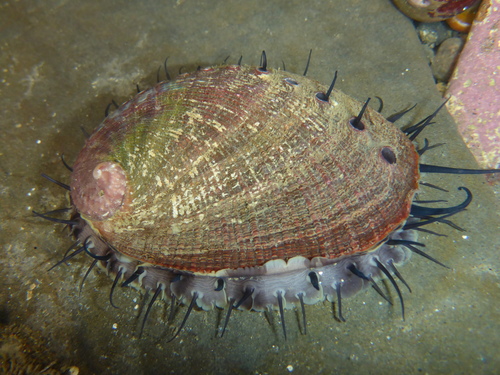
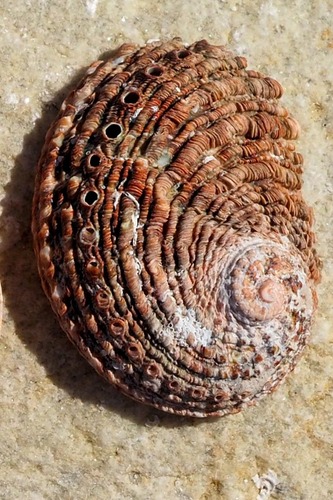
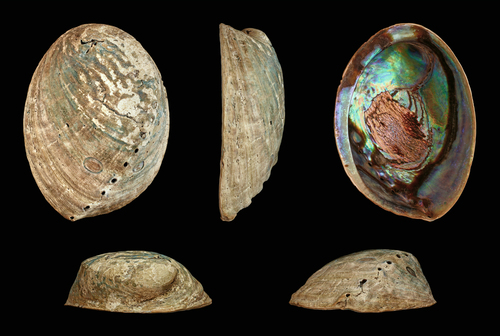
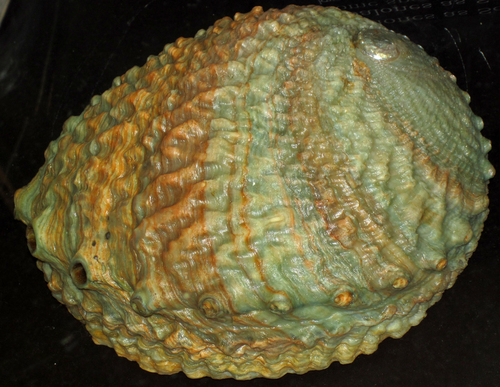
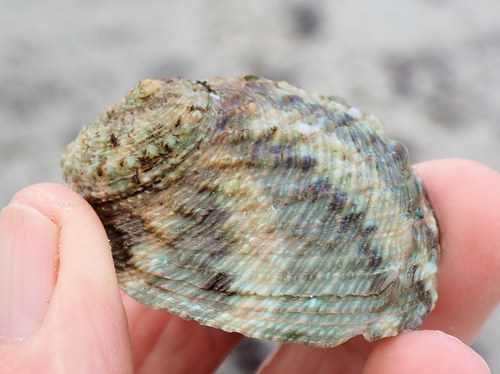
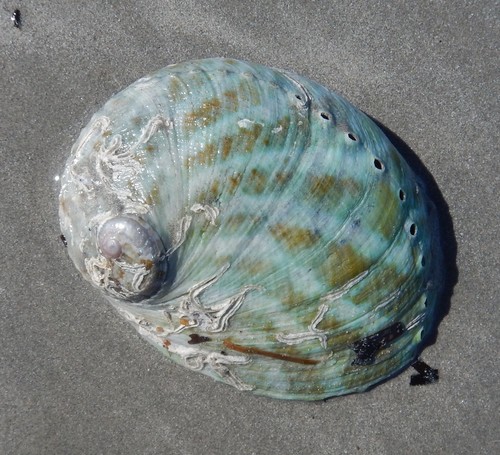
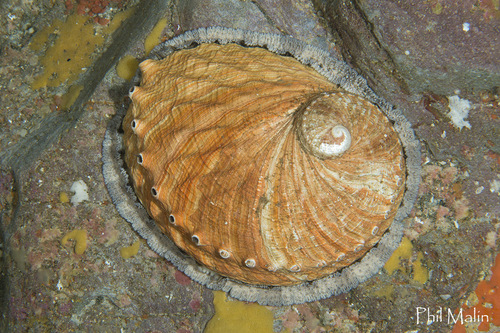
The shell of Haliotis rubra Leach, 1814 ranges in size from 3.5 to 20 cm (1.4 to 7.9 inches). This large, very depressed shell has a rounded-oval shape, with the apex positioned one-fifth of the shell’s total length away from the margin. Its surface is sculpted with fine spiral cords, crossed by closely spaced minute increment striae, and marked with radiating waves or folds on the upper surface. There is a slight angle along the row of perforations; below this row, the shell is broadly excavated and then carinated. Around six perforations are present, which are elevated and circular. The overall shell outline is suborbicular, very depressed, solid but not thick. Shell surface color is variable: it may be dark red with a few radiating angular white patches, or dull red and green with streaks and mottling; overall color ranges from dark coral red to dull red streaked with pale green. The spiral cords of the outer surface are either nearly equal in size, or have slightly larger cords spaced at wide intervals, and are decussated by close growth-striae. The shell contains just over 3 whorls. The inner shell surface is corrugated similarly to the outer surface, silvery, and very brilliantly iridescent, with reflections that are predominantly sea-green and red. The columellar plate is broad, flat, and obliquely truncated at its base. The cavity of the spire is wide and open, but shallow. This species is endemic to Australia. Its natural range extends from Fremantle, Western Australia, to Angourie, New South Wales, and also includes the waters around Tasmania. It is one of two abalone species harvested in South Australia and Tasmania, with the other being the greenlip abalone. It is commonly called blacklip abalone because the edge of its foot is black.