About Haliotis midae Linnaeus, 1758
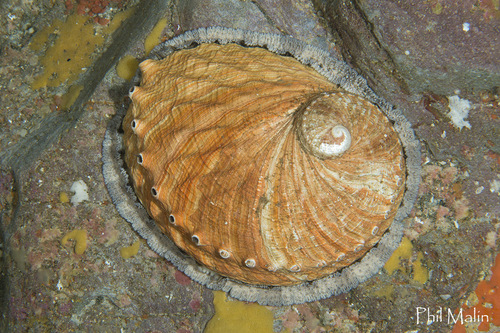
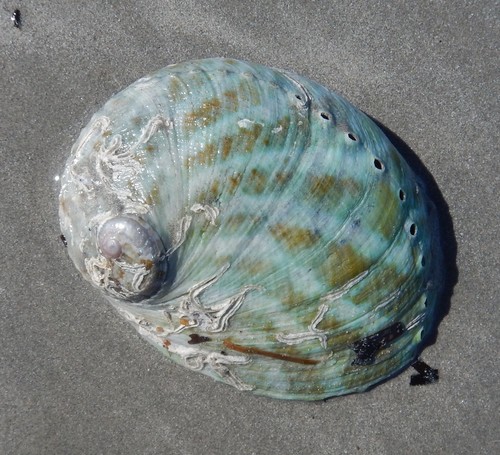
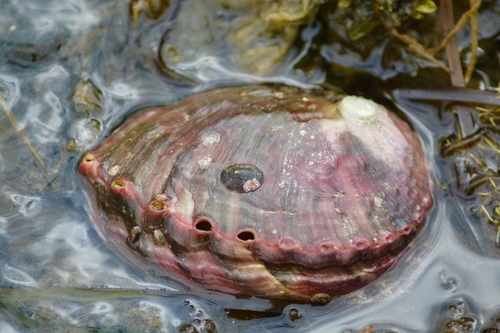
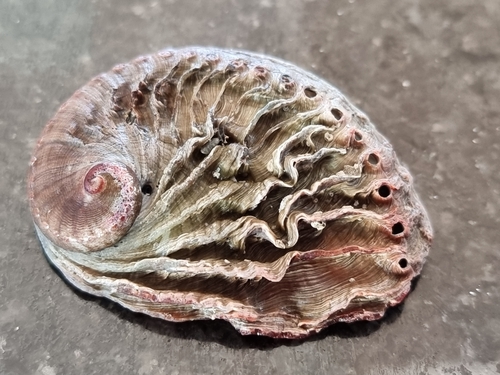
Haliotis midae Linnaeus, 1758, has a shell that measures between 12 and 20 cm (4.7–7.9 in) in length. The large shell has a rounded-oval shape and is moderately convex. The apex sits at a distance from the margin that is about one-fifth of the shell’s greatest length. The body whorl is strongly angled at the location of the shell perforations, and descends perpendicularly from this angle to the columellar margin. The outer surface of adult shells has strong, elevated radiating wrinkles or lamellae, and lacks spiral markings. The shell has 6 to 11 small, subcircular perforations, separated by spaces that are larger than the diameter of the perforations themselves. The two sides of the shell are curved to roughly the same degree, and the degree of overall convexity changes with age. The shell is yellowish-grey, and its folds are usually stained coral-red. The outer surface is dull, marked with fine oblique growth-wrinkles and coarse, prominent, less oblique elevated wavy radiating lamellae. The low spire is made up of around 3 whorls, and the body whorl is angled at the row of perforations. The inner surface of the shell is pearly and multicolored; red is the dominant color in young specimens. The muscle scar is large and rounded, and it is very rough, especially in older shells, which often have coppery stains inside. The columellar plate is rather broad, measuring between one-seventh and one-tenth of the shell’s total width, and slopes inward. The face of the columellar plate is slightly concave, and is not truncated at the base. The cavity of the spire is large, and reveals about 1½ whorls when viewed from below. This species is endemic to the waters off the coast of South Africa.