About Haliotis laevigata Donovan, 1808
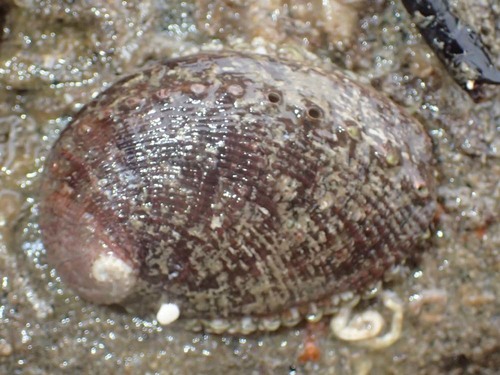
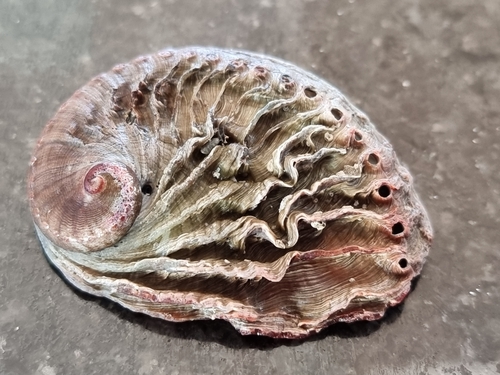
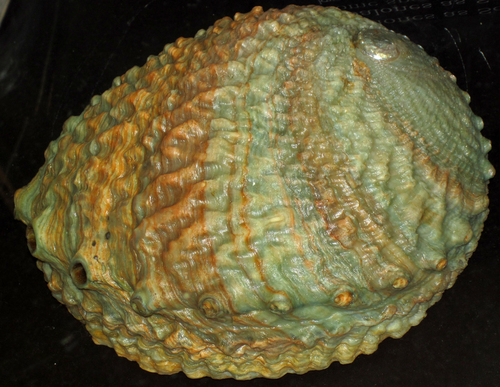
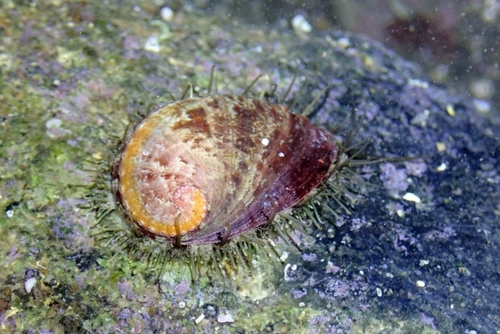
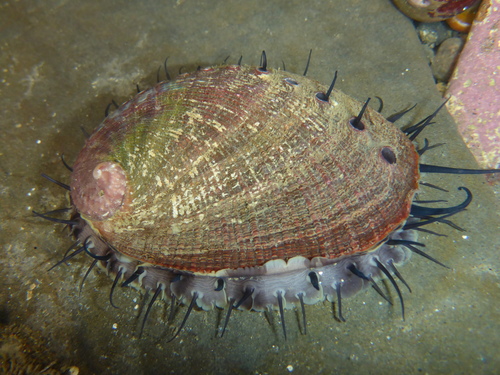
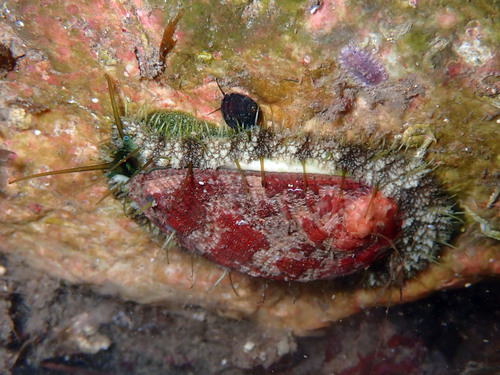
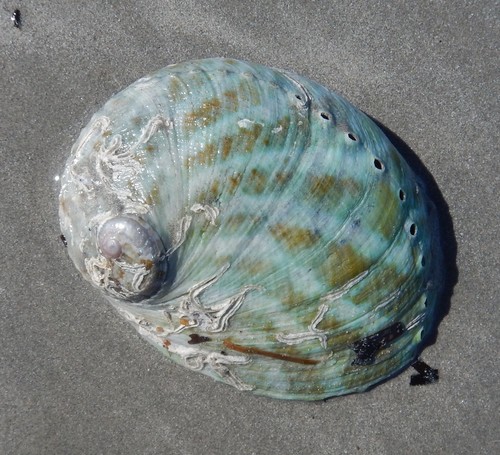
This species, commonly called the greenlip abalone, has a shell that reaches a maximum length of 18 cm (7 in). It can be identified by a distinctive green ring around the foot at the base of its shell. The shell is large, somewhat thin, and oval-shaped. The apex is positioned between one-sixth and one-eighth of the total shell length away from the shell margin. The shell is nearly smooth, with faint, obsolete spiral lirae; its surface is sculpted with similarly faint spiral threads and cords. The shell color is orange or orange-scarlet, marked with radiating, continuous white flame-shaped patterns, and also has continuous oblique stripes of scarlet and whitish. There are around 12 unusually small perforations, with borders that are not raised outside the shell surface. The overall outline of the shell is oval, with both the right and left margins curving to a similar degree. The back of the shell is convex and rounded, with no angulation along the row of perforations. The spire is moderately elevated, and contains about 2½ whorls. The inner surface of the shell is silvery; the nacre is almost smooth, with faint traces of spiral sulci and very fine wrinkling. The columellar plate is relatively wide, slopes inward, is flattened, and is obliquely truncated at its base. The cavity of the spire is large and fairly shallow. This marine species is endemic to Australia, and can be found off the coasts of South Australia, Victoria, Western Australia, and Tasmania. In Tasmania, it occurs primarily along the northern coast, especially around Rocky Cape, and also lives in the Furneaux Islands. Legally sized greenlip abalone are unlikely to be found without scuba diving at depths greater than 30 ft (9 m). This is one of two abalone species harvested in large quantities in Australia, alongside the blacklip abalone. As wild populations have declined, the genome of this species has been sequenced as a preliminary step for potential aquaculture development, as the species has a large, highly palatable muscular foot.