About Haliotis kamtschatkana Jonas, 1845
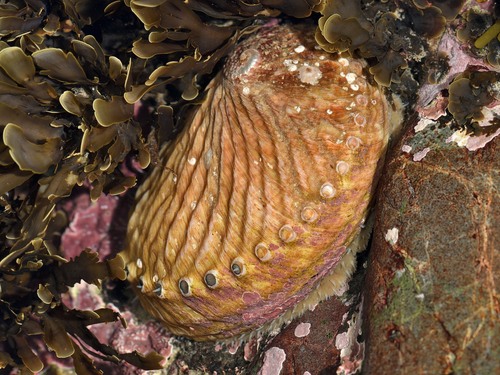
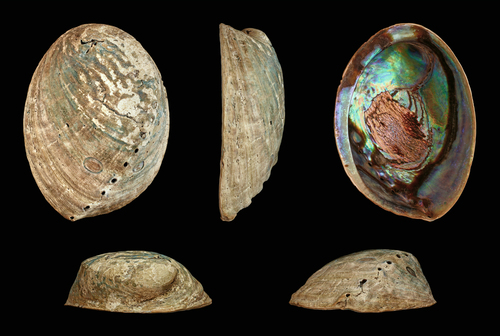
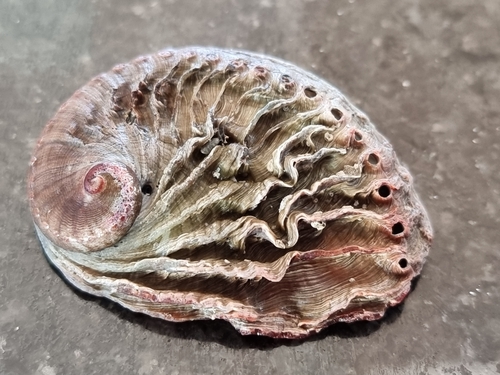
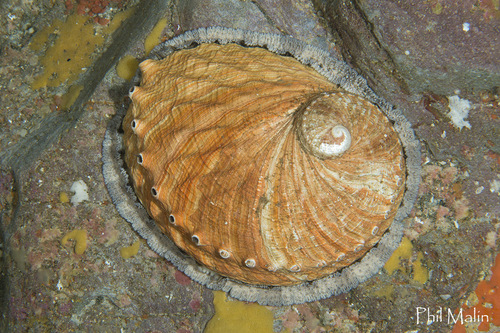
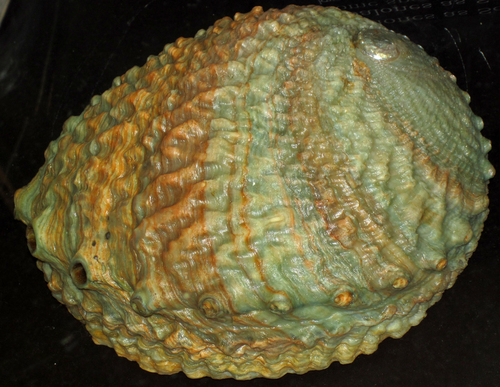
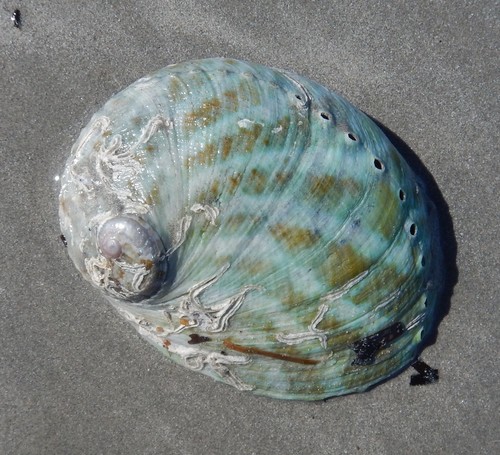
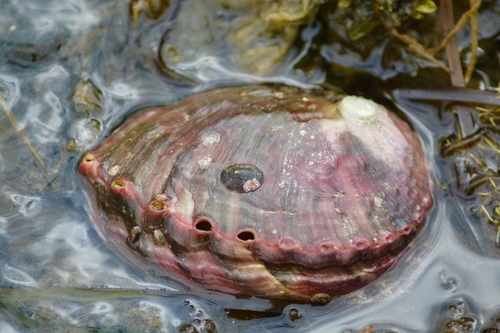
Pinto abalone (Haliotis kamtschatkana Jonas, 1845) typically reach an adult shell size of approximately 8 cm (3.1 in), and rarely grow as large as 15 cm (5.9 in). Their shell is rather thin, flattened, and ear-shaped. The shell surface is covered with uneven, often very indistinct spiral cords, plus strongly elevated undulations or lumps. The columellar shelf is narrow, flattened, and sloped inward. The shell has 3 to 6 elevated respiratory holes; these holes collectively form the selenizone, which develops as the shell grows. The interior of the shell is silvery and iridescent. The outer shell is generally green-brown, may have white or blue patches, and has a somewhat scalloped edge. The epipodium is lacy and green-brown. Tentacles that surround the foot and extend out from the shell function to sense food and predators.
Pinto abalone occur in kelp beds and rocky areas of the northeast Pacific Ocean, ranging from Salisbury Sound, Alaska, along the coasts of Canada and the contiguous United States, down to Baja California, Mexico. This is the Pacific abalone species with the widest latitudinal distribution in North America. This species inhabits rocky shores. It is found intertidally or subtidally near kelp at depths up to 9 m (30 feet), and can also occur at depths down to 100 m (330 feet). Like all abalone, pinto abalone are herbivorous.
Pinto abalone reproduce via broadcast spawning from April to June. Their larval dispersal is limited, and individuals have a maximum lifespan of about 15 years. For the Tlingit and Haida peoples, both the consumption of pinto abalone meat and the use of their shells have held cultural significance.