About Haliotis iris Gmelin, 1791
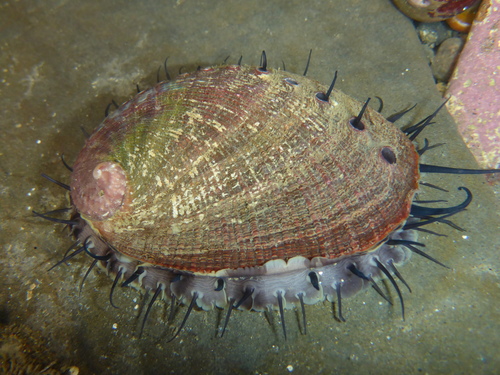
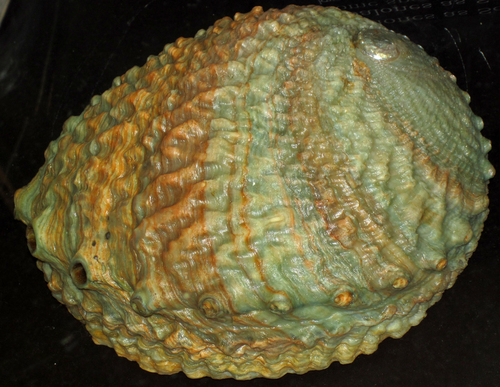
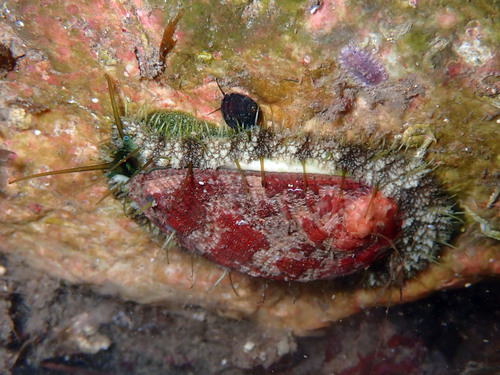
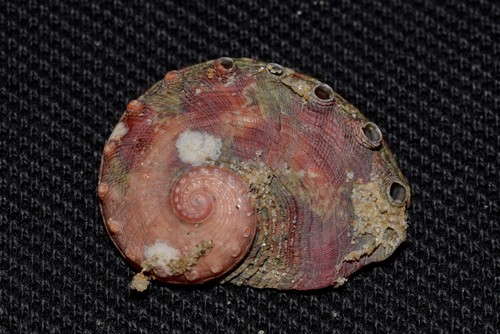
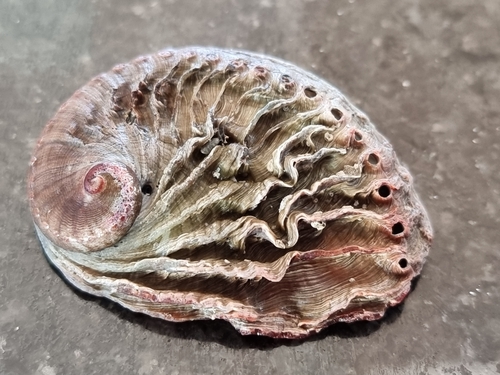
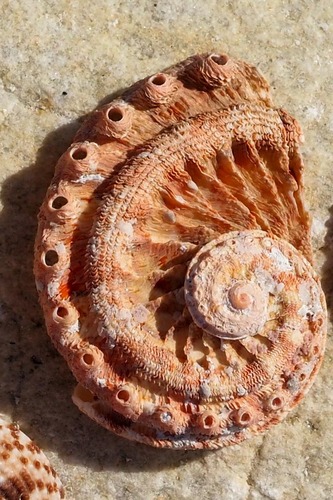
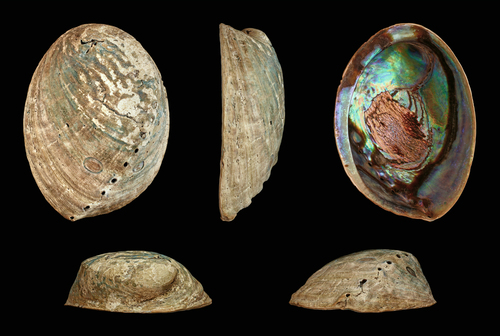
Pāua are part of the molluscan genus Haliotis, more commonly known as abalone. The genus name Haliotis comes from Greek, meaning "sea ear", which refers to the ear-like shape of the abalone shell. Three abalone species occur naturally in New Zealand: blackfoot pāua (Haliotis iris), yellowfoot pāua (Haliotis australis), and whitefoot pāua (Haliotis virginea). For Haliotis iris, shell size ranges from 80 to 170 mm (3.1 to 6.7 in), and the species can grow to around 180 mm (7.1 in) in shell width. The shell of this species is oval and convex, with both sides equally curved. Its oblique spire is very short, containing two whorls and five to seven perforations. The shell surface is pitted. The lip is continuous and extends beyond the body whorl. The inner shell surface is dark metallic blue and green, with yellow reflections. The muscle impression is distinct and roughened. The back of the shell is convex and angled at the row of perforations. The outer shell surface is pale brown or light olive-green, and is pitted by the intersection of two series of low oblique folds. The inside of the spire is brilliantly pearly, with prussian blue and green as the dominant colors, plus additional reflections of purple, orange, and a small amount of red. The columellar plate is broad, and connects to the expanded continuation of the outer lip above. It is not truncate below. Its face is flattened and slopes inward. The cavity of the spire is small. This marine species is endemic to New Zealand. Blackfoot pāua is the largest abalone species found in New Zealand. It is most commonly found in shallow cool waters at depths less than 6 m (20 ft). The species can be found all around mainland New Zealand, Stewart Island, and the Chatham Islands. These sea snails often form large clusters in the sub-littoral zone on open, exposed coasts, where drift seaweed accumulates and water movement is good. Haliotis iris is the only farmed pāua species in New Zealand. This is mainly due to its larger size compared to its smaller relatives, yellowfoot pāua and the even smaller whitefoot pāua. Both smaller relatives are also commonly used for jewellery, arts, and carvings across New Zealand. There is a worldwide trade in natural pearls from this species, which are called Haliotis iris pearls or pāua pearls.