About Haliotis fulgens R.A.Philippi, 1845
Scientific name: Haliotis fulgens R.A.Philippi, 1845
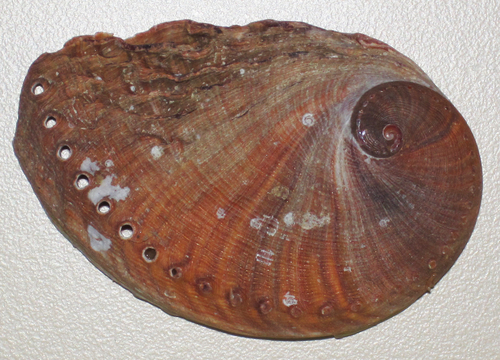
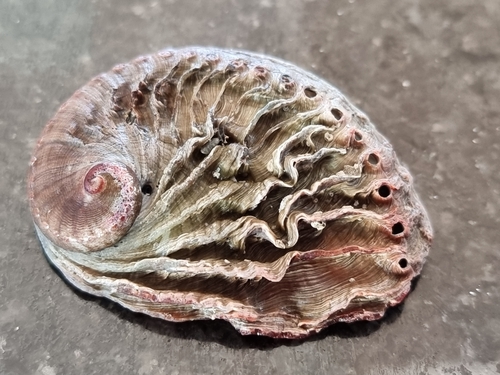
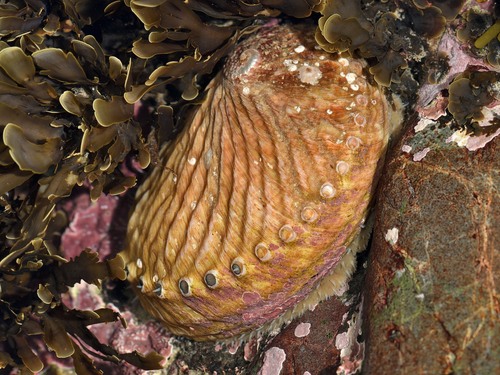
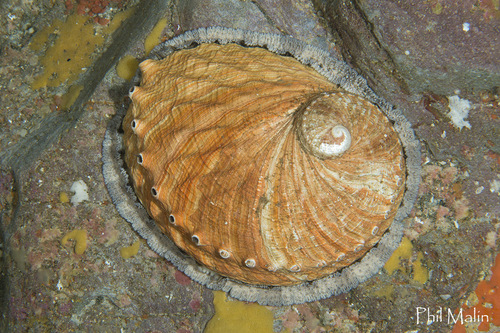
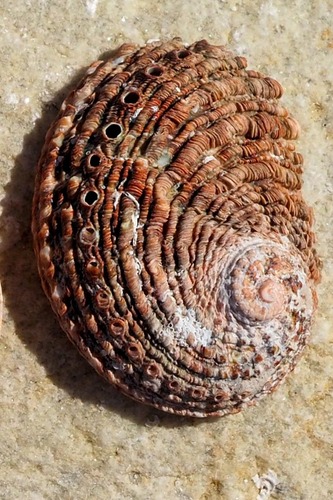
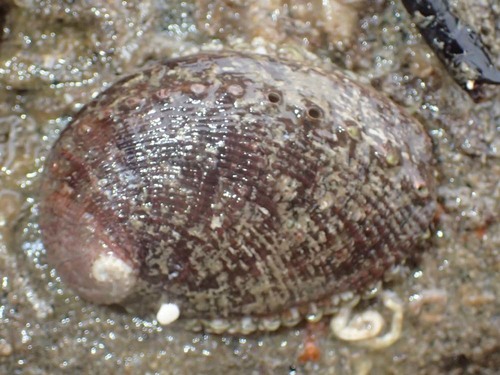
Description: The adult shell of this species measures between 75 mm (3.0 in) and 255 mm (10.0 in) in size. The shell is large, oval, quite convex, solid, but thinner than the shell of Haliotis rufescens. The entire outer surface of the shell is sculptured with equal-sized rounded cords, also called lirae. There are 30 to 40 of these rounded spiral lirae on the upper surface of the shell. Its overall coloration is a uniform dull reddish-brown. At the row of open shell holes, there is an angle; the surface below this angle slopes almost perpendicularly to the columellar edge, and has an obtuse keel about midway down this slope. The spire does not project above the general curve of the shell's back. Generally five small, elevated, circular holes remain open on the shell. The inner surface of the shell is dark, mostly blue and green with dark coppery stains, and the area inside the spire is pinkish. The muscle impression on the inner shell has a distinctive brilliant pattern, similar to a peacock's tail. The columellar plate is wide, flat, and slopes inward. The cavity of the spire is small and almost completely concealed.
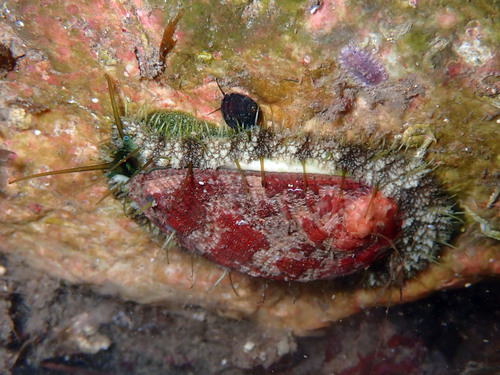
The epipodium is a ruffled edge of tissue running along the side of the foot. In this species, the head and epipodial tentacles are olive green. The epipodial fringes are mottled cream and brown, with scattered knobby tubercles across their surface and a frilly edge.
Distribution: H. fulgens is endemic to coastal waters ranging from Point Conception, California, USA, south to Bahia Magdalena, Baja California Sur, Mexico.
Habitat: This species lives in shallow water along open, exposed coasts, found from the low intertidal zone down to at least 9 m (30 feet), and possibly as deep as 18 m (60 feet). Individual abalone occupy rock crevices, spaces under rocks, and other hidden, enclosed cavities. Like all abalone, Haliotis fulgens (commonly called green abalone) is herbivorous. It feeds mostly on drift algae, and prefers fleshy red algae.
Reproduction: Green abalone have separate sexes, and carry out broadcast spawning from early summer through early fall. Individuals reach maturity when their shell is between 2.4 to 5 inches (61–128 mm) in length, which is at an age of 5 to 7 years. Green abalone can live for 30 years or more.