About Haliotis diversicolor Reeve, 1846
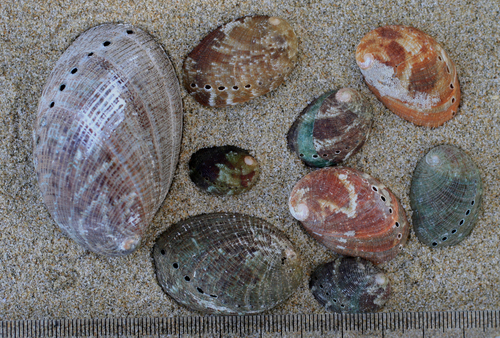
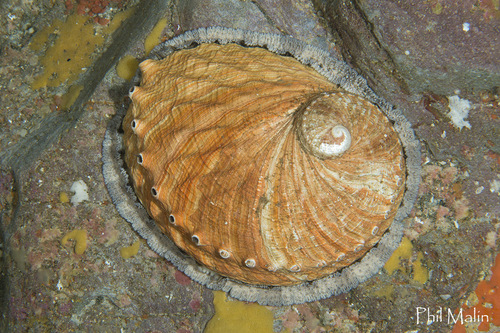
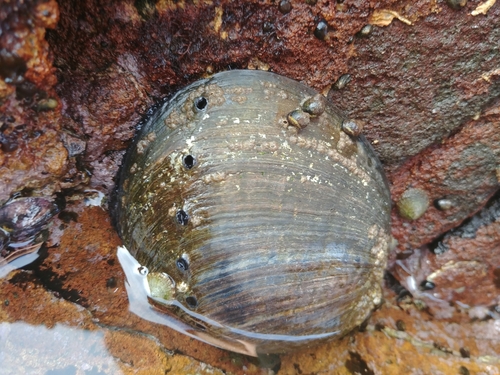
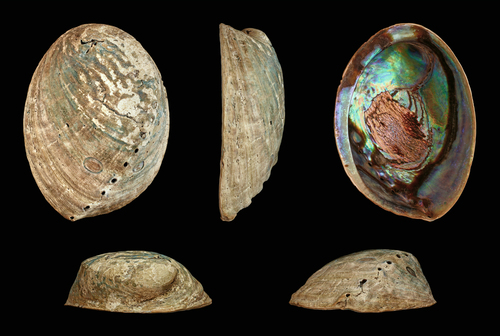
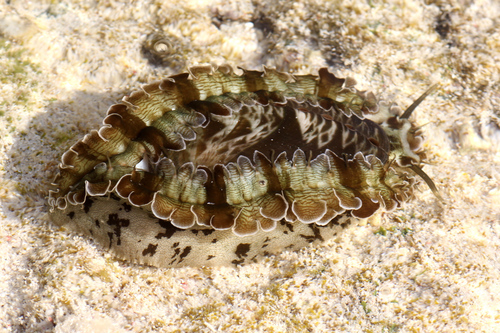
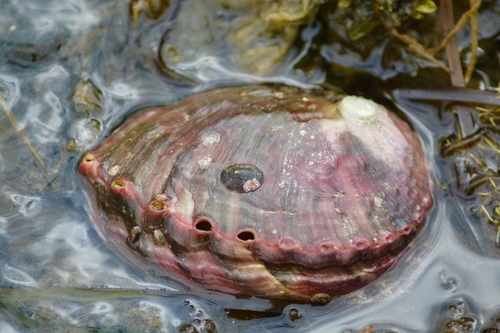
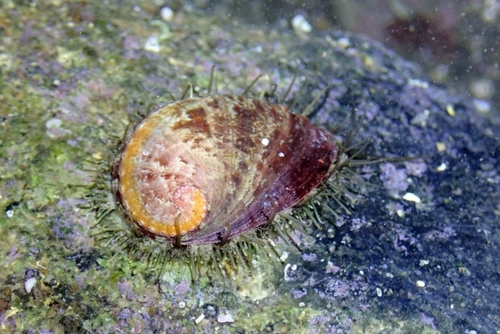
Description: The shell of Haliotis diversicolor Reeve, 1846 ranges in size from 25 mm to 85 mm. The shell has an elongated oval shape, with the spire positioned very close to the margin. The shell surface is spirally lirate, with lines that are unequal and rounded. These lines are crossed by low folds that mark the former positions of the peristome. Its color pattern consists of irregular patches and streaks of reddish-brown, scarlet, and green, and overall coloration of the species is highly variable. The oval perforations on the shell typically number between 7 and 9. There is no angle along the row of perforations, and the space between the perforations and the columellar margin holds unequal spiral cords that are not coarser than the cords found on the rest of the disk. The inner surface of the shell is silvery, with reflections of light green and red. Both sides of the shell are equally curved, and the back is quite convex. The columellar plate is rather narrow, flattened, and slopes inward, with no truncation at the base. It is wide enough at the top to completely conceal the cavity of the spire. This variable species tends to have quite bright coloration, and is distinguished by its long oval shape, numerous perforations, and spiral liration. Distribution: This species is found in the temperate northwestern Pacific Ocean. It occurs off the coasts of Japan, Taiwan, and Vietnam, specifically at Bạch Long Vĩ, Cô Tô, and Hạ Long Bay. It is also found off Australia’s Northern Territory, Queensland, and Western Australia, in Indonesian waters around Bali, and off the coast of New Caledonia. Shells from Bali and New Caledonia differ slightly from the holotype: they are somewhat more elongated and have a dark sepia color.