About Haliotis cracherodii Leach, 1814
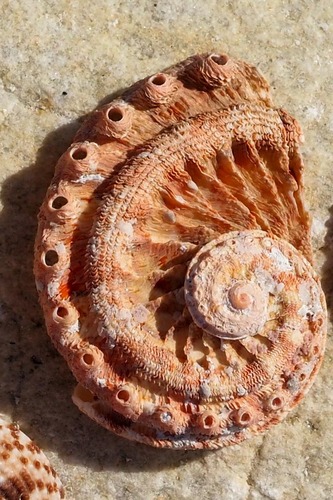
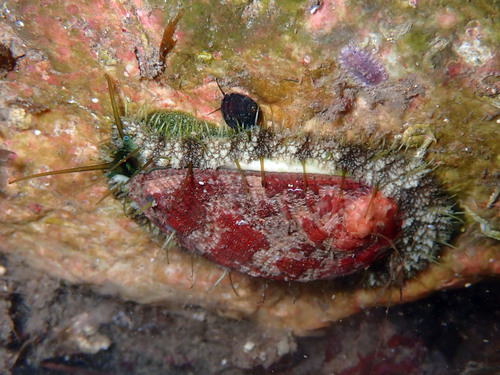
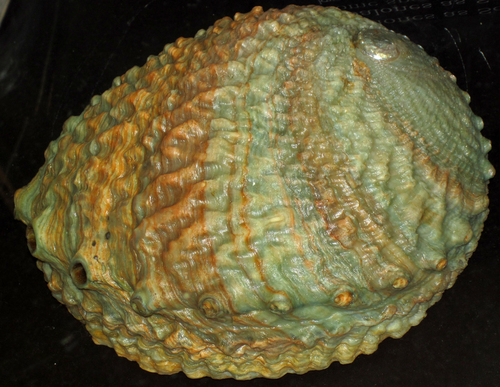
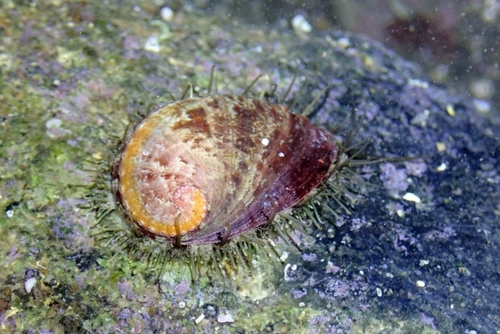
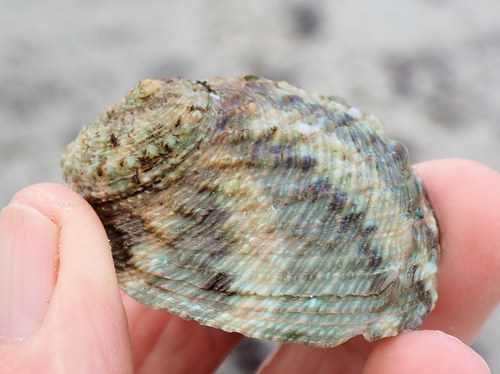
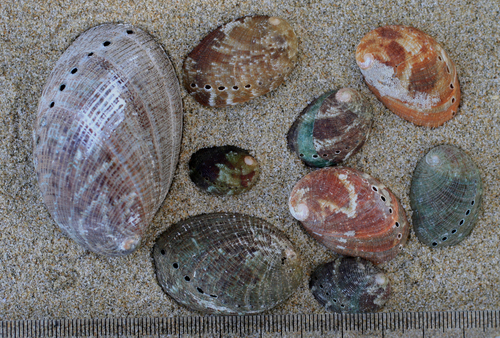
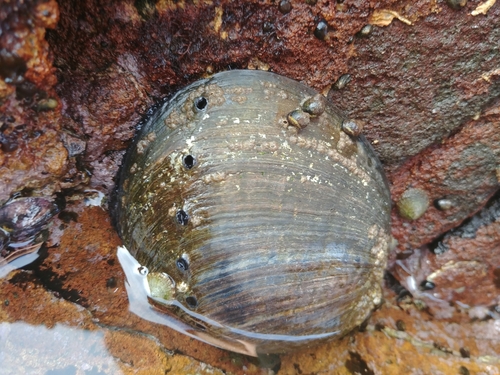
This species, commonly called black abalone, has the scientific name Haliotis cracherodii Leach, 1814. Its shell coloration can be dark brown, dark green, dark blue, or almost black. The silvery interior of the shell has pale pinkish and greenish iridescence, and is overall pearly with pink and green iridescence. Compared to most other abalone, the shell's exterior is smoother, though it may have low, indistinct coarse spiral lirae and growth lines. The shell has an oval shape, is evenly convex, and has equally curved sides. The back of the shell is regularly convex, with very little algal growth. The shell does not have a keel along the row of holes. The spire sits near the margin, its cavity is very small, and is either completely or nearly concealed. The muscle scar is generally not distinct. Five to seven small, open respiratory pores are usually present along the left side of the shell, and the rims of these holes are flush with the rest of the shell. These holes together form the selenizone, which develops as the shell grows. The columellar plate is not truncate at the bottom, slopes inward, and has a concave face. The rear of the shell is spiralled, and the mantle, foot, and tentacles of the animal are black. In living individuals, the tentacles on the epipodium, mantle, and foot are also black. The maximum shell length of this species is 20 cm (7.9 in), with a typical length of 10–14 cm (3.9–5.5 in). Black abalone are distributed along the Pacific coast of the United States from Mendocino County, California to Cabo San Lucas, Baja California, Mexico. Prehistoric distribution across most of this range is confirmed by archaeological recovery from various Pacific coastal Native American sites; for example, Chumash peoples in central California's Morro Bay area harvested black abalone approximately one thousand years ago. The subspecies Haliotis cracherodii californiensis occurs around Guadalupe Island, off Baja California, Mexico. Black abalone cling to rocky surfaces in the low intertidal zone, at depths up to 6 m. During low tide, they are typically found wedged into crevices, cracks, and holes. They generally live in areas with moderate to high surf. Juveniles stay in crevices to lower their risk of predation, while larger adults move out onto open rock surfaces. Black abalone reach sexual maturity at 3 years of age, and can live 30 years or more; they are also thought to have a total lifespan between 25 and 75 years, and begin reproducing between three and seven years of age. Spawning most often takes place in spring and early summer, and occasionally a second spawn occurs in the fall. Black abalone are broadcast spawners, and successful spawning requires individuals to be close together. Larvae are free-swimming for 5 to 14 days before settling onto hard substrate, usually near larger individuals, where they metamorphose into their adult form, develop a shell, and attach to the rock. Juveniles do not tend to disperse far, so current populations are generally made up of locally spawned individuals. Juveniles settle in crevices and remain hidden until they reach approximately 4 inches in length, after which adults gather in more exposed areas such as rocks and tide pools. Humans have harvested black abalone along the California Coast for at least 10,000 years. On San Miguel Island, archaeological evidence shows that the Island Chumash people and their ancestors ate black abalone for millennia, and also used the shells to make fishhooks, beads, and ornaments. After Chumash and other California Indian populations were devastated by European diseases, and sea otters were nearly eliminated from California waters by the historic fur trade, black abalone populations recovered. This rebound led to an intensive intertidal fishery operated primarily by Chinese immigrants from the 1850s to around 1900.