About Haliotis corrugata W.Wood, 1828
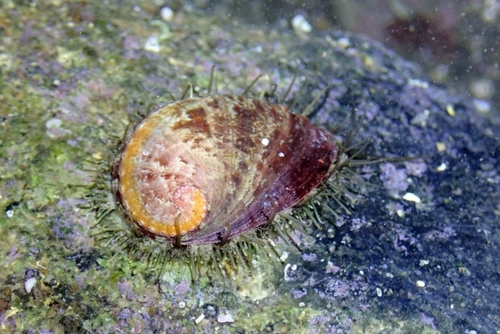
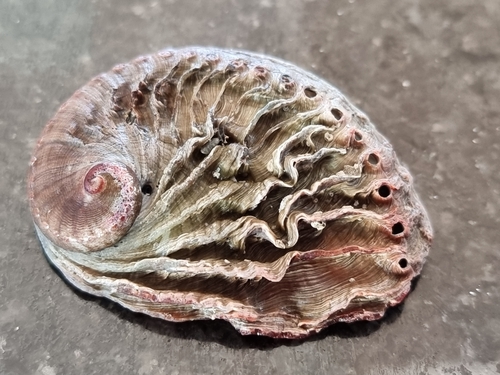
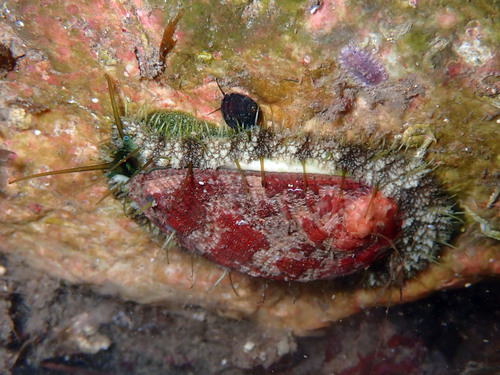
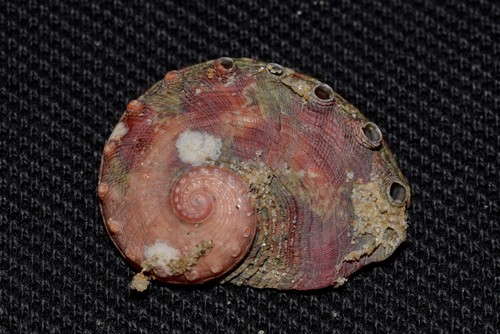
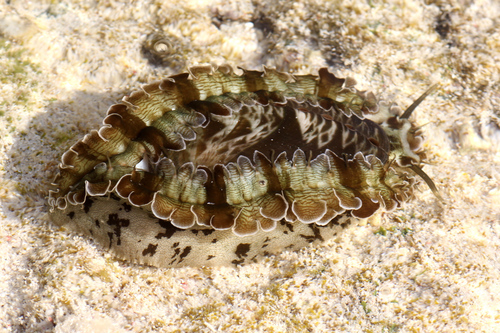
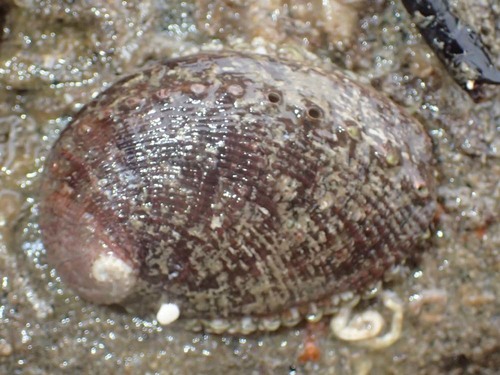
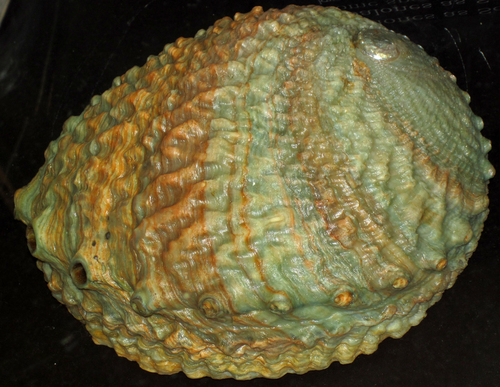
Haliotis corrugata W.Wood, 1828, commonly known as pink abalone, has a thick shell marked by strong corrugations, and is more circular than other American abalone species. It has two to four open respiratory apertures with edges strongly elevated above the shell surface; these holes collectively form the selenizone, which develops as the shell grows. The epipodium is a "ruffle" of tissue along the side of the foot. The head and epipodial tentacles are black, while epipodial fringes are mottled black and white, with many surface tubercles and a lacy edge. The large shell is subcircular or short oval, very convex, and shaped like a half-globe. The entire shell surface is covered with nodose, corrugated wrinkles. Open perforations are normally three (sometimes two), elevated and tubular. The strong outer epidermis is dull olive-brown, usually with wide oblique greenish intervals. Shell sculpture starts as crowded spiral cords or lirae; over most of the body whorl, these become nodose at short intervals, or are crossed by obliquely radiating corrugations. The shell is angled at the row of perforations. Below the perforations lies a distinct spiral channel or furrow, bounded below by a more or less distinct row of nodules. Between this channel and the columellar margin, the shell is obliquely corrugated, and folds scallop the lower part of the columellar margin. The spire does not project above the shell's general outline. The inner shell surface is dark and very brilliantly iridescent, with red dominating the coloration. The large, distinct muscle impression is roughened all over, and its brilliant coloration resembles fine mosaic work. The flat or concave columellar plate slopes strongly inward, is not truncate at the base, and almost conceals the small spire cavity above it. Pink abalone are found along the Pacific coast of North America, from Point Conception, California to Bahia de Santa Maria, Baja California Sur, Mexico. This species occupies sheltered waters at depths between 20 and 118 feet (6 – 36 m). They are herbivores, feeding on kelp and drifting algae. Pink abalone have separate sexes, and broadcast spawn from March to November. Individuals reach maturity at about 1.4 in (35 mm) length, or at three to four years old. Their lifespan is 70 years or more.