About Haliotis australis Gmelin, 1791
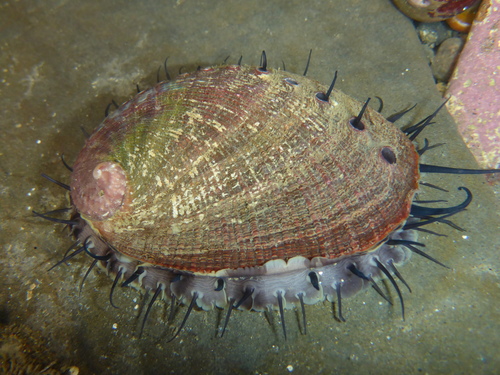
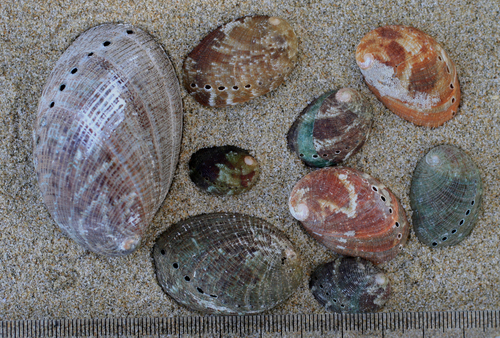
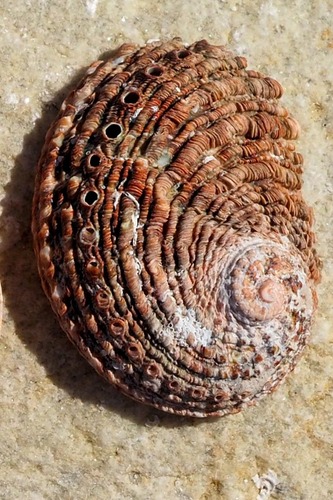
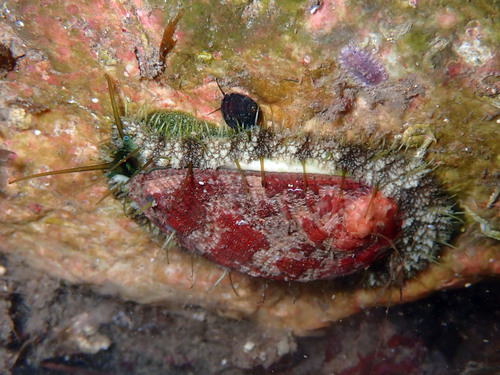
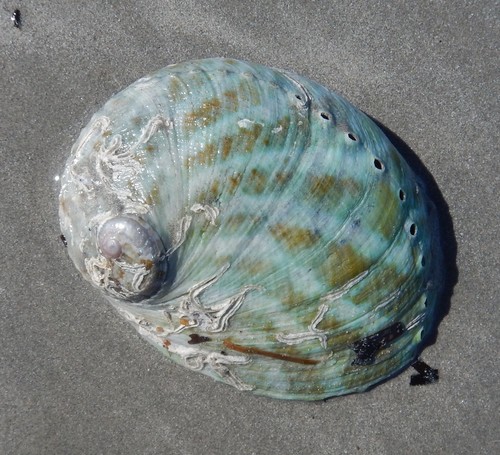
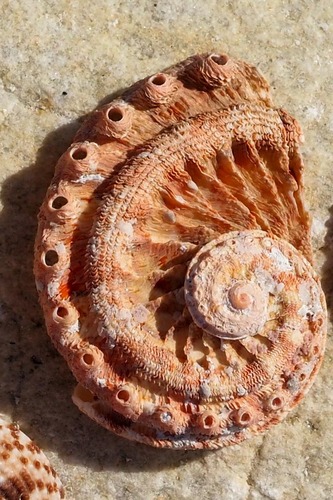
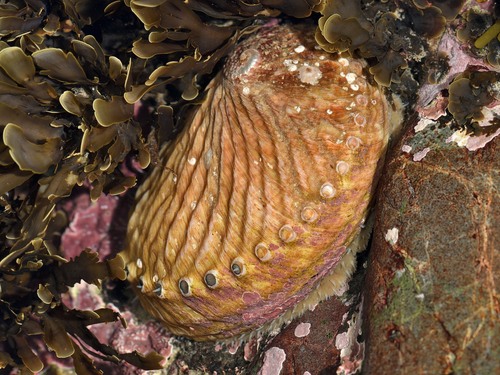
This species has the scientific name Haliotis australis Gmelin, 1791. The shell of this species ranges in size between 40 mm and 100 mm. The thin, oval shell is quite convex. The distance from the shell apex to the margin measures between one-eighth and one-ninth of the full shell length. The shell’s sculpture is made up of faint spirals and a close, strong radiating corrugation. It has 6 to 8 circular perforations with elevated edges. The overall outlines of the shell are oval, and the right margin is slightly straighter. The back of the shell is convex, and it is not carinated at the row of holes. The color pattern can be light yellowish-brown with red on the spire, or light green with red flame-shaped markings. The surface has nearly obsolete spiral cords, along with regular, close, radiating folds. Between the row of holes and the columellar margin, there are no radiating folds, but instead several (usually three) strong spiral ribs. The spire is slightly elevated and contains three whorls. The interior of the shell is corrugated just like the exterior, and it is silvery with reflections of blue, green, and red, with red reflections predominating. The columellar plate is narrow. The corrugated texture of the shell exterior is a constant, characteristic trait of this species. Young specimens have stronger spiral ribs, and often have red radiating stripes against a delicate green base background. This species is endemic to New Zealand, and can be found across the country. In New Zealand, Haliotis australis is commonly called 'Queenies', and it is grouped with three other Haliotis species under the collective name 'pāua'. All these species, including Haliotis australis, are used as a food source. Haliotis australis shells are generally smaller than those of the related species Haliotis iris, but they are still harvested commercially and recreationally. Harvested individuals must have a minimum shell length of 80mm.