About Haliotis asinina Linnaeus, 1758
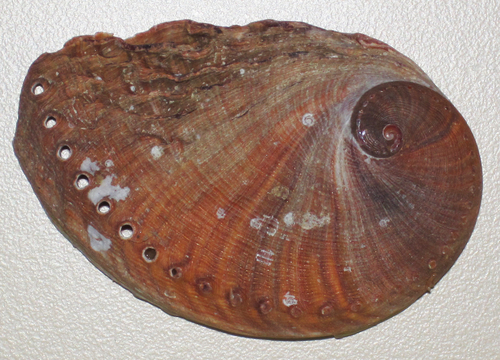
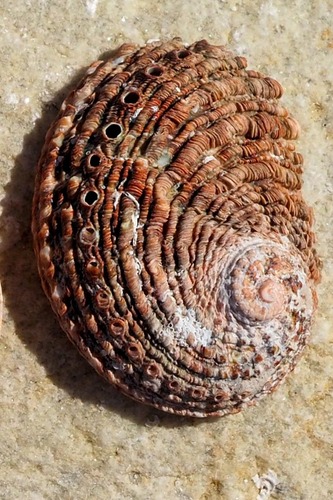
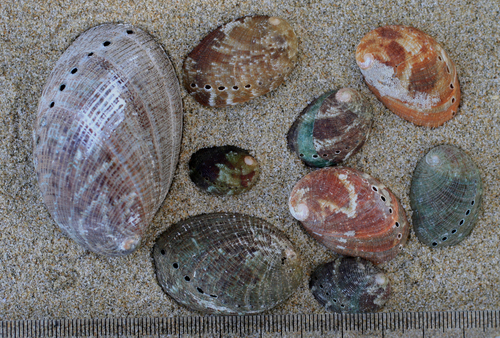
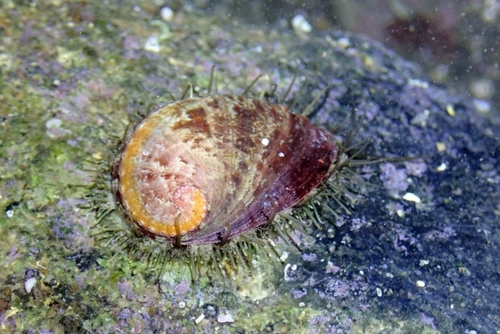
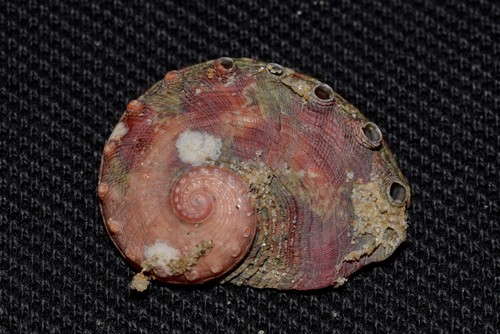
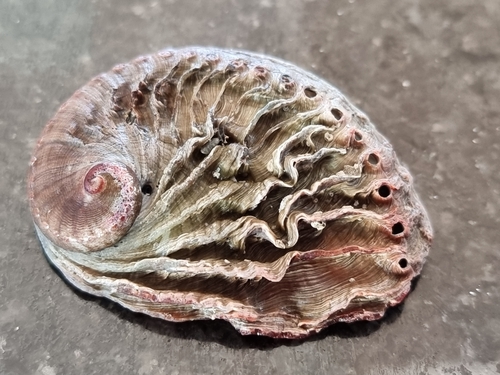
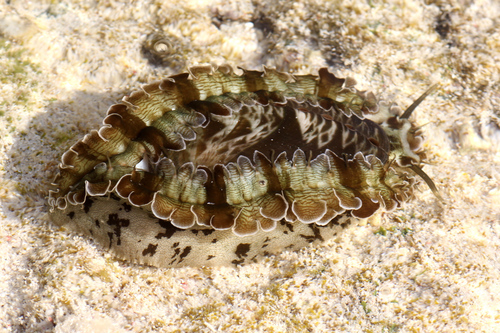
The maximum shell length of Haliotis asinina reaches 120 mm (4+3⁄4 inches), though most individuals commonly grow to around 90 mm (3+1⁄2 inches). Its shell has a distinctly elongated shape that closely resembles a donkey ear, which is the origin of its common name. In living individuals, the smooth outer shell surface is almost completely covered by the mantle, so encrustations from other animals like barnacles are much less common than in other abalone species. The shell of H. asinina has 5 to 7 oval open holes on the left side of the body whorl. These holes together form the selenizone, a structure that develops as the shell grows. Its spire is somewhat noticeable, with an apex that is mostly positioned posteriorly. The external shell color ranges from olive green to brown, marked with distinct roughly triangular patches. Like many other abalone, the inner surface of the shell is strongly iridescent, with pink and green tones. This is an Indo-West Pacific species, ranging from the Eastern Indian Ocean to the Central Pacific. It is common in the Andaman and Nicobar Islands, Pacific islands, southern Japan, and Australia (Northern Territory, Queensland, Western Australia). This abalone lives in shallow water coral reef areas of the intertidal and sublittoral zones, most commonly found at depths around 10 m (33 ft). While the species itself is quite abundant, large aggregations of H. asinina are uncommon. The life of Haliotis asinina shows several major transitions in shell pattern and morphology. It has a pelagobenthic life cycle that includes a planktonic period of at minimum three to four days. Biomineralization starts shortly after hatching; the larval shell, or protoconch, is formed over approximately 10 hours. The initial differentiation of biomineralizing cells likely involves localized thickening of the dorsal ectoderm, followed by cell invagination to form the shell gland. The shell gland then evaginates to form the shell field, which expands through mitotic divisions to direct the precipitation of calcium carbonate (CaCO3) via secretion of organic molecules. This process forms the larval protoconch. Construction of the haliotid protoconch finishes after torsion. These structures allow veliger larvae to fully retract into a protective space and exit the water column rapidly. The next phase of biomineralization does not start until the competent veliger larva encounters an environmental cue that triggers metamorphosis. The protoconch remains developmentally inactive until the animal receives this specific cue to initiate metamorphosis. The postlarval shell, or teleoconch, is deposited quickly after metamorphosis, with significant variation in production rate between individuals. The transition from the protoconch (larval shell) to the teleoconch (juvenile/adult shell) is clearly visible at metamorphosis, which indicates that a different biomineralizing secretome is active. The early postlarval shell is more robust and opaque than the larval shell, but it has no pigment. Even though the early teleoconch has no pigment, it is textured and opaque enough that postlarval shell growth can be easily distinguished from the larval shell. Several weeks after metamorphosis, the juvenile Haliotis asinina teleoconch quickly develops a uniform maroon color, matching the crustose coralline algae (CCA) that larvae settle on. When the individual reaches about 1 mm (39 mils) in size, further changes in the mantle's morphogenetic program appear in the shell. A distinct series of ridges and valleys, plus a line of respiratory pores called tremata, have formed. This is also the developmental stage where the first identifiable nacre tablets can be detected. In terms of color, the uniform maroon background is now broken by pale cream patches, and dotted with a pattern of dots that only appear on ridges; these dots are blue over the maroon background and orange over the cream background. This shell pattern may improve the juvenile's ability to camouflage on the heterogeneous background of the CCA it lives in at this stage. This pattern gradually fades as the animal grows, and the shell becomes thicker and more elongated. At 10 to 15 mm (13⁄32 to 19⁄32 in), this elaborate color pattern begins to fade, as the maroon and cream areas blend into a brown background. Blue and orange dots still remain on the ridges. With additional growth, the ridge and valley structure fades to produce a smooth adult shell that has irregular brown-green triangular patches on a light brown background. These large-scale morphological changes are accompanied by mineralogical and crystallographic changes. Clear, well-defined nacre tablets are present in shells larger than approximately 5 mm (3⁄16 in), and they are absent or poorly defined in shells 1 mm (39 mils) or smaller. In larger shells, a ventral cap of CaCO3 that lies beneath the aragonitic nacre tablets continues to thicken. Overall, the ontogenetic changes in Haliotis asinina shell pigmentation and structure match changes in the habitats the species occupies during development. The growth rate of Haliotis asinina is the fastest of all abalone species. Individuals reach sexual maturity in one year. The flesh of Haliotis asinina is edible, and it is typically collected for food and for its shell in Southeast Asian countries.