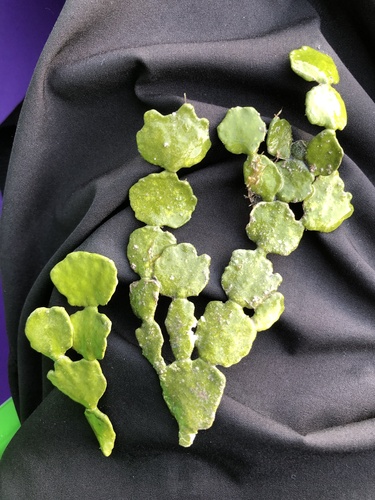
About Halimeda tuna (J.Ellis & Sol.) J.V.Lamour.
Halimeda tuna is a calcareous green seaweed that attaches to the seabed via a holdfast. Each individual thallus, or frond, is formed by a single cell structured as a multinucleated tube. The cytoplasm is mobile, allowing nuclei, chloroplasts, and other cell contents to move freely inside the cell wall. This tube is divided into flattened, disc-like segments connected by flexible joints. The surface of these segments has swollen structures called utricles, which together form a tabular "cellular pavement". Gaps exist below and between these utricles; in these gaps, fluid becomes saturated with calcium carbonate, and crystalline aragonite needles form. These needles stiffen the segments and make the seaweed unpalatable to fish. When Halimeda tuna dies, its calcified skeletal material breaks down into sand. Members of the Halimeda genus are likely among the most important calcification agents in the marine environment, with considerably higher calcification productivity in tropical seas than stony corals.
This species is distributed in the tropical and subtropical Indo-Pacific region, the Mediterranean Sea, and the western Atlantic Ocean. It grows on rocky reefs, ranging from the shallow subtidal zone down to depths of approximately 70 m (230 ft). In the Mediterranean Sea, it occupies two distinct habitat types: shallow warm lagoons and sheltered areas in the central Mediterranean, and 18 m (60 ft) deep rocky habitats in the northwest Mediterranean. Similarly, in the Florida Keys, it is the dominant green alga in both shallow back reef locations and much deeper, low-light reef slope habitats.
The thallus of this seaweed is often overgrown by epiphytes, which reach their maximum abundance in summer. Segments are sometimes damaged by storms, but new growth replaces damaged segments; this new growth occurs as temperatures rise, alongside increases in irradiation and dissolved nutrients. In deepwater Mediterranean habitats, Halimeda tuna is the dominant species, and is often found growing alongside the encrusting red alga Mesophyllum lichenoides. In this habitat, it tends to grow on vertical walls, under overhangs, and in other low-sunlight positions. Its adaptation to dim light is supported by the presence of two accessory photosynthetic pigments: the green-absorbing carotenoids siphonein and siphonaxanthin, in addition to chlorophyll a and chlorophyll b. In Florida, reproductive events happen simultaneously across the reef, with up to 5% of thalli developing gametangia. Asexual reproduction also occurs through fragmentation, or via the growth of vegetative stolons.
As a human food, this seaweed has been described as pleasant to eat when served with oil, vinegar, and salt.

