About Halictus sexcinctus (Fabricius, 1775)
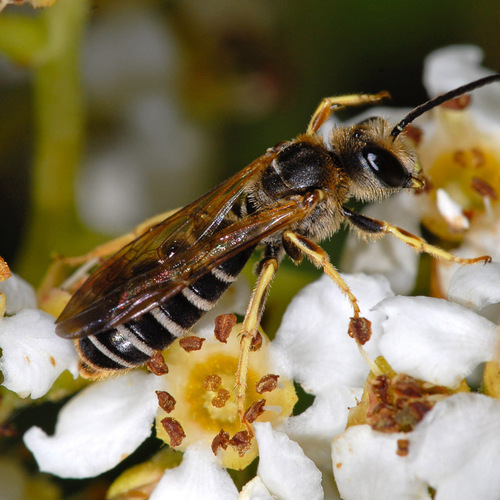
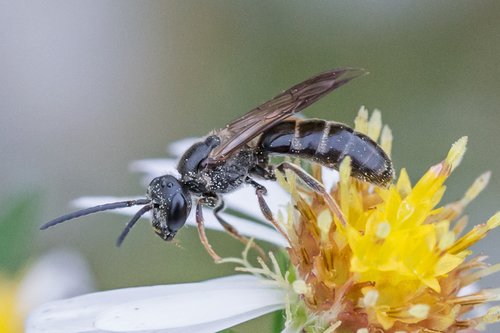
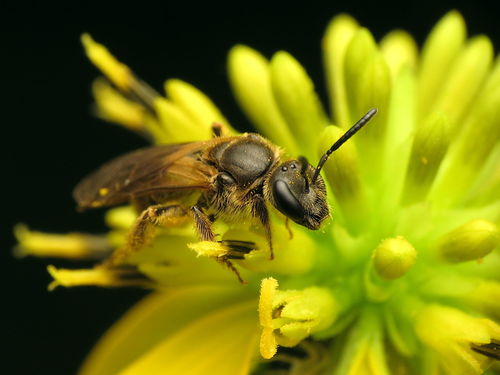
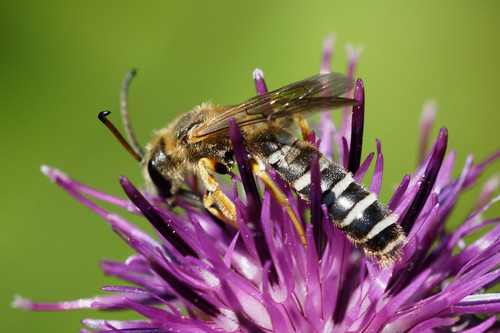
Halictus sexcinctus, first described by Fabricius in 1775, is a species of ground-nesting sweat bee. It was previously thought to only display solitary behavior. This species is relatively large compared to other sweat bees, with individuals ranging from 14 to 16 mm in total length, and has white felt bands on its abdomen. Within a nest, workers are typically smaller than foundresses, and foundresses are usually the largest and most worn individuals. Sterile and reproductive workers do not differ in body size. This species exhibits variable social organization. In eusocial nests, queens act aggressively, and fights to the death can occur if another female attempts to usurp the original foundress. In communal nests, females show little to no aggression toward each other, and foundresses continue to join the colony during the founding period, which runs from late May to early June. Female workers show a range of behaviors depending on their nest's social organization, from completely selfish behavior to eusocial helping behavior. Halictus sexcinctus has been very important for research into the evolution of eusociality. Phylogenetic analysis indicates this species had a social ancestor, and its existing solitary populations are an example of evolutionary reversal. Morphological differences correspond to different social strategies in this species. Communal females vary in size from the size of a worker to the size of a eusocial queen, but all communal females have proportionally shorter wings than solitary and eusocial females. This indicates communal females follow a different developmental pathway. The morphological differences between communal and eusocial individuals represent a novel preimaginal developmental difference, which suggests their behavioral differences also originate before the imaginal (adult) stage. This difference may be caused by environmental factors during the larval period, such as differential feeding by queens. It remains undetermined whether different social organizations in this species arise from environmental-induced phenotypic plasticity, a common trait in halictine bees, or from genetic differences. Genetic differences are unlikely to cause relative sterility, as genes for this trait would not be passed on to future generations. The mechanism that produces the morphological differences between different social strategies is not yet understood. Halictus sexcinctus is commonly found across Europe, ranging as far north as southern Sweden and as far east as Turkey and Iraq. Populations are solitary in the northern portion of the species' range, and social in the southern portion. In central Europe, even though populations are solitary there, the bees live in very large aggregations. This bee prefers to nest in sandy or loamy soil. It uses its mandibles to dig nests in the ground, and can even dig nests on vertical earthen substrates. Nests consist of a main diagonal tunnel dug into the ground, with several short side chambers branching off to lead to brood cells. A small tumulus forms around the nest entrance. One egg is laid per brood cell, placed on top of a mixture of nectar and pollen. Females generally forage on plant species with wide-open flowers, and primarily collect pollen from plants in the family Asteraceae, including asters, daisies, and sunflowers.