About Halictus confusus Smith, 1853
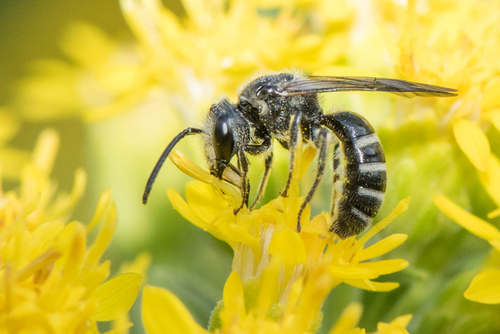
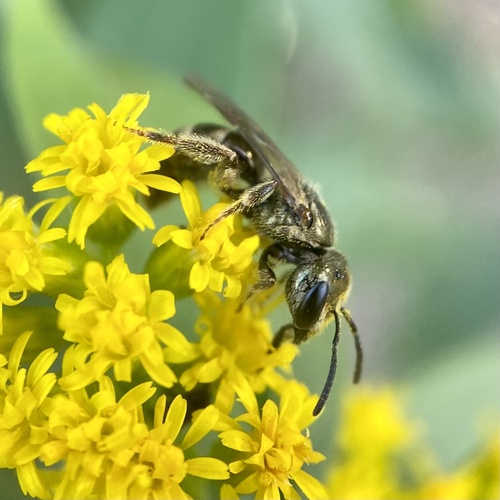
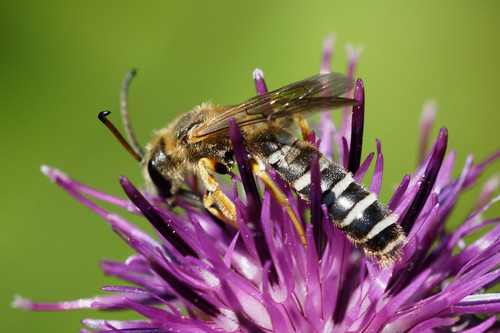
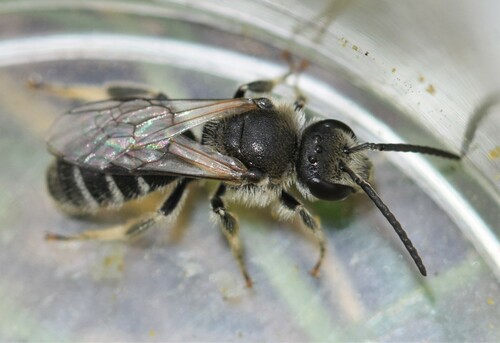
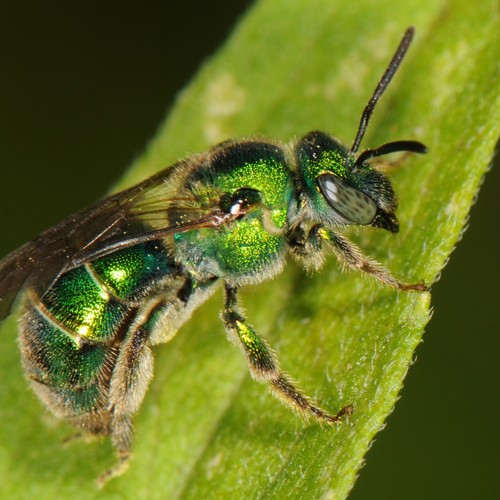
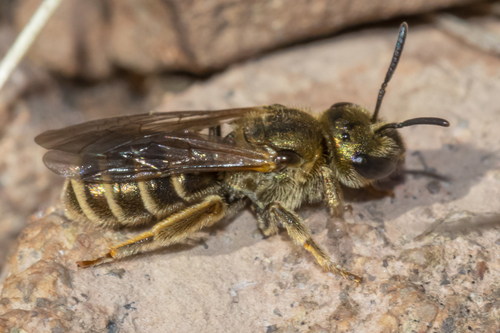
Halictus confusus measures 7 millimetres (0.28 in) in total length, with a forewing that is 5.5 millimetres (0.22 in) long. For females, the head and thorax are greenish, darkening to blackish on the clypeus; the abdomen is black, with metallic greenish highlights. The legs are blackish, turning reddish toward their distal ends. The head is slightly broader than it is long, with eyes that converge slightly ventrally and an obviously protruding clypeus. The wings are hyaline with yellow venation, and the tegulae are yellowish on the anterior portion and reddish elsewhere. Males are generally similar in overall form, but their mandibles, labrum, and outer third of the clypeus are yellow; their wing venation is more reddish, and their legs have a narrow outer yellowish stripe on the tibia plus yellowish tarsi. In Britain and Europe, this species can easily be confused with Halictus tumulorum, and can only be reliably distinguished by examining the male genitalia. More subtle distinguishing features exist: fresh female H. confusus have wider pale banding on tergites 3 and 4, while males have more yellow on the joints of the middle and hind legs. Halictus confusus is widely distributed across Europe, Asia, and North America. A number of subspecies have been described, including: H. c. confusus Smith, 1853, found in North America; H. c. alpinus Alfken, 1907, recorded from China, Poland, Spain, and Switzerland; H. c. arapahonum Cockerell, 1906, found in Midwest North America; H. c. pelagius Ebmer, 1996, found in Russia; and H. c. perkinsi Blüthgen, 1926, found in western Europe (excluding higher mountain areas) and China. In Great Britain, this species has a southerly distribution, ranging from Dorset east to Kent and north to Norfolk. In North America, its distribution extends from Nova Scotia to North Dakota, southward into Florida and Texas. In Britain, Halictus confusus shows a strong association with sandy areas such as sandy heaths and sand pits, but across the rest of its broad range, the species appears to be more generalist in its habitat choices. It is a polylectic bee that feeds on a wide variety of flowers, visiting different species throughout its active season. In one North American study, newly emerged queens favored spring beauty (Claytonia virginica), while toothwort (Cardamine concatenata) was used to a lesser extent. When these woodland flowers faded in April, the bees switched to dandelions as their main food source; these early plants were mainly used to immediately feed the newly active bees. When wintercress (Barbarea vulgaris) began to flower abundantly in meadows and orchards, this plant became the main resource used by the species, and bees collected its pollen to provision their nests. When flowers became scarce in late May, bees continued foraging but widened their range of visited flowers, until they closed off nests in June and remained inside with the developing brood. After the first brood of workers emerged, workers and subsequent broods foraged on clover. In late summer, after clovers faded, the last brood fed on other flower species, including Lespedeza lineata and Symphyotrichum ericoides. These late-season bees were reproductive females and males; mated females would go on to overwinter. Halictus confusus nests in aggregations, and exhibits a primitive form of eusociality with behaviorally distinct castes that are not morphologically different. Nests have the potential to develop into a matriarchy with a mother queen and daughter workers. A queen founds a new nest each spring, which has a horizontal entrance tunnel beneath a mound, and this entrance is guarded by bees. As in related species, workers of this species may become reproductively capable, and the queen's ability to prevent this depends on colony size and the size difference between the queen and workers. Foraging adults are preyed on by crab spiders and predatory bugs, while ants are the main predators of nests (especially unguarded nests, though ants may also attack guarded nests by overcoming the guard bee). The main parasites of adult females are conopid flies, while phorid flies lay eggs inside nests by tailgating returning workers to get past guards. The parasitic beetle Ripiphorus walshi is a larval parasite; its triungulin larvae attach to adult bees when the bees visit flowers, and are carried back to the nest. Other parasites of Halictus confusus include fungi and nematodes.