About Haliclona caerulea (Hechtel, 1965)
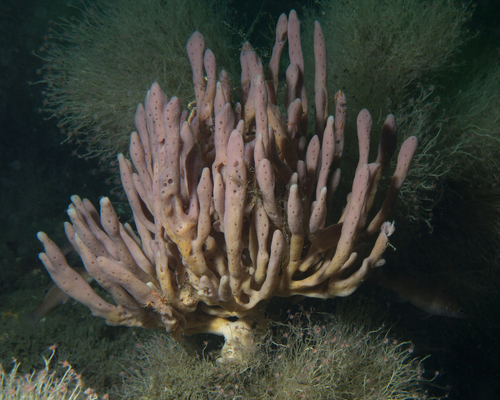
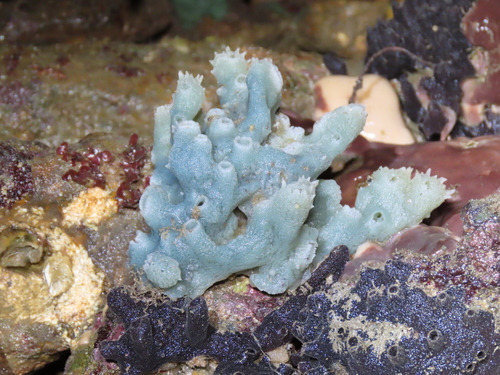
Morphologically, Haliclona caerulea grows as an encrusting mass made up of cylindrical to volcano-shaped projections that measure between 2 and 15 cm long. Oscula are located at the upper end of each projection; these openings are circular or oval, with diameters ranging from 1.3 to 5.0 mm. The body of Haliclona caerulea has radial symmetry. Its outer layer is composed of flattened cells called pinacocytes, while its inner layer is formed by flagellum-bearing cells called choanocytes. Choanocytes serve two functions: they ingest food particles, and they maintain the flow of water through the sponge's body. A more or less gelatinous substance called mesohyl lies between these two cell layers. Specialized cells called sclerocytes secrete a supporting body skeleton made of spongin fibers. As its scientific name suggests, the most common body color of this species is blue, though individual sponges may also be beige or white. Geographically, Haliclona caerulea is native to the western tropical Atlantic, ranging from Florida and the Gulf of Mexico through the Caribbean Sea to the West Indies. It also occurs on the Pacific coasts of Mexico and Panama, and has been introduced to the islands of Hawaii and Guam, most likely via accidental transport through biofouling on ship hulls. Haliclona caerulea most commonly grows in beds of the seagrass Thalassia, and in habitats made up of rocky coral rubble. Scientific studies have documented that this sponge engages in symbiosis with the calcareous alga Jania adhaerens.