About Halichoeres richmondi Fowler & Bean, 1928
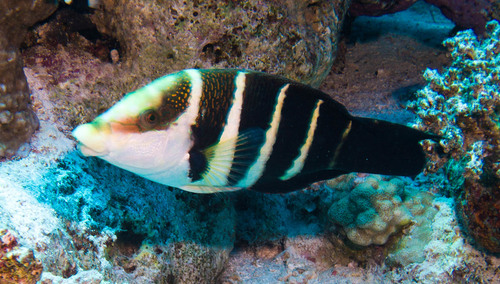
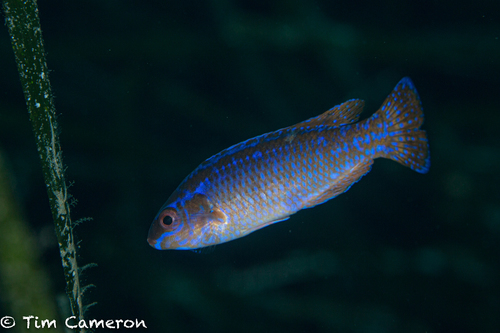
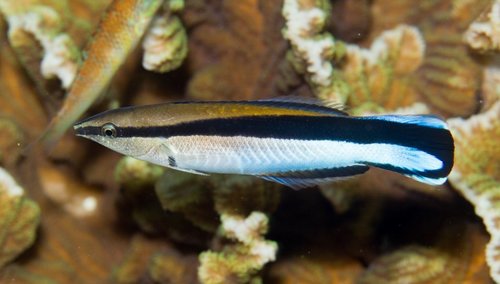
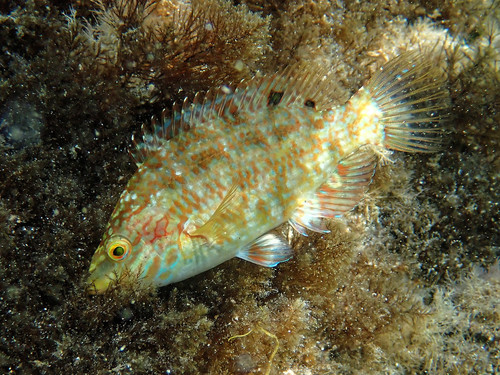
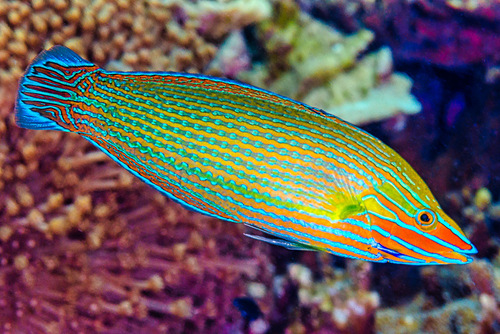
Halichoeres richmondi, commonly called Richmond's wrasse or chain-lined wrasse, is a small fish that can reach a maximum total length of 19 centimetres. It has a thin, elongated body with a terminal mouth, and a more pointed snout than other wrasses in the genus Halichoeres. Its body coloration shows limited variation based on age. Juveniles have a light blue-green base body color marked with numerous orange stripes, plus two black ocelli: one on the upper section of the caudal peduncle, and a second in the middle of the dorsal fin. A black spot is also present on the first rays of the dorsal fin. Both juveniles and females share an orange anal fin. Mature males have quite different appearance: their bodies are greenish with many chain-like blue lines on the fins, they have a concave, green-brown colored head profile, and the outer margins of their dorsal, caudal, and anal fins are blue. Halichoeres richmondi was formally described in 1928 by American ichthyologists Henry Weed Fowler and Barton Appler Bean, with the type locality recorded as Inamucan Bay on Mindanao in the Philippines. The specific epithet honors American ornithologist Charles Wallace Richmond (1868–1932) of the United States National Museum. This wrasse is widely distributed across tropical and subtropical waters of the central Indo-Pacific, ranging from Indonesia to the Philippines, and from the Solomon Islands to southern Japan. It lives in shallow water, at depths down to 12 metres, and inhabits lagoons and channels that are rich in soft coral.