About Halichoeres poeyi (Steindachner, 1867)
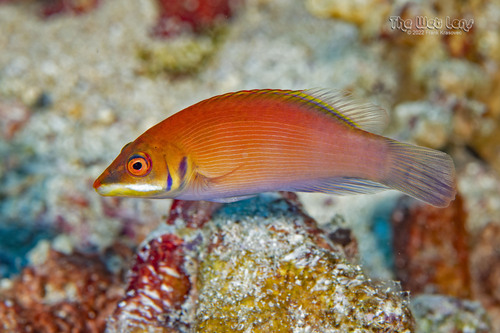
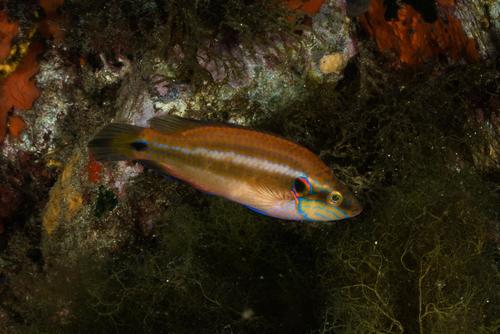
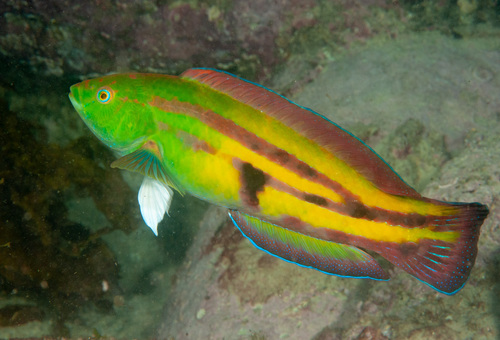
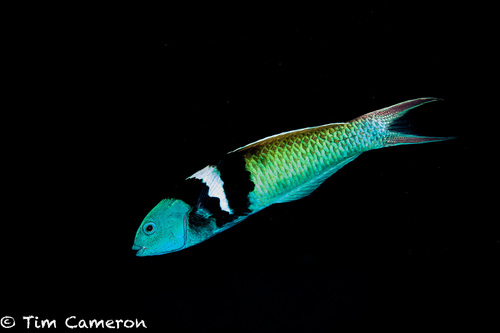
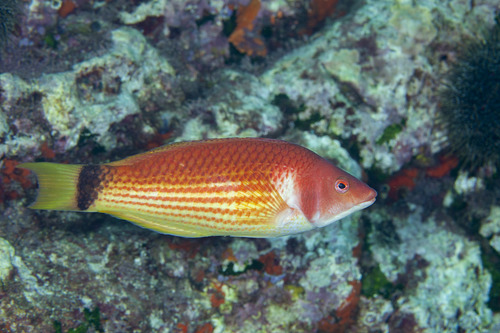
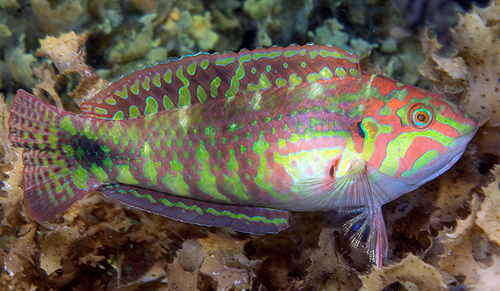
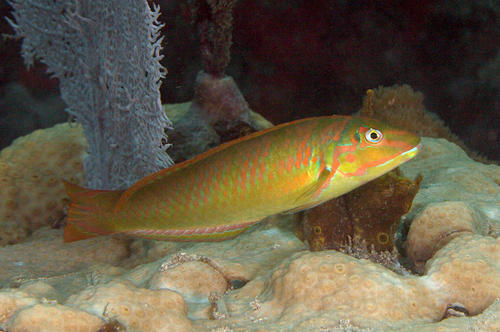
Halichoeres poeyi, commonly called the blackear wrasse, has a relatively long, thin body, a large eye, and a pointed snout ending in a terminal mouth that holds protruding canine-like teeth. Its pectoral fins extend all the way to the vent. The species has wide pink bands and a narrow blue stripe across its head and tail, and it has a dark spot behind the eye that gives the fish its common name. The background color of both the head and body is olive, and each scale is outlined with pinkish-red. The margin of the dorsal fin is blue and orange, while the caudal fin is dull yellow marked with diagonally converging blue and rose lines. Males and females have similar patterns, but males grow larger than females. There is an additional black spot on the spine close to the origin of the dorsal fin. The dorsal fin is made up of 9 spines and 11 soft rays, and the anal fin has 3 spines and 12 soft rays. The maximum recorded total length of Halichoeres poeyi is around 20 cm (7.9 in).
The blackear wrasse is distributed in the western Atlantic Ocean, ranging from southern Florida and the Bahamas south to Santa Catarina in southern Brazil. Due to its small size, this species is generally of little interest to commercial fisheries, but it is traded in the aquarium hobby. In Brazil, companies that catch this species for the aquarium trade have been subject to a quota since 2004, which is set at 1,000 fish per year per company.