About Halichoeres hortulanus (Lacepède, 1801)
The checkerboard wrasse, scientifically named Halichoeres hortulanus (Lacepède, 1801), is a small fish that reaches a maximum length of 33 centimetres (13 inches). Both its sex and appearance change over its lifetime, and coloration at each life stage varies quite a bit based on location. It has a thin, relatively elongated body and a terminal mouth.
As juveniles, this wrasse has a silvery-white base color, with three black and dark red vertical patches located on the back of the head, the middle of the body, and the caudal peduncle. A black ocellus surrounded by a yellow ring marks the rear of the dorsal fin, and two distinct white spots are visible on the top and bottom of the caudal peduncle. A reddish line also runs through the eyes, starting from the tip of the snout.
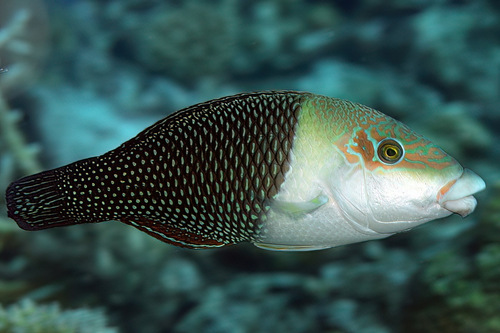
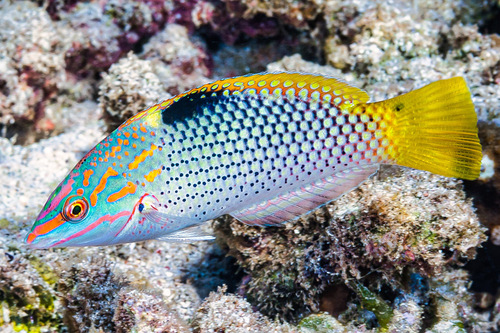
In the terminal phase, after sex is determined at maturity, coloration varies widely. The checkerboard wrasse has a white to greenish base color, with blue to black coloring along the edges of its scales, creating a pattern that resembles a checkerboard. The head is greenish, with pink lines that extend into dots behind the eyes, all the way to the base of the dorsal fin. A bright yellow spot appears at the border between the side of the body and the dorsal fin. Some color variation occurs: there may be a black spot just behind this characteristic first yellow spot, and a second bright yellow spot can be seen along the edge of the dorsal fin near its end. In the Red Sea, the rear half of some individuals may be blue. The caudal fin is truncated, and is usually yellow with a pinkish pattern that can fade or become completely blue.
The checkerboard wrasse is widespread across tropical and subtropical waters of the Indian Ocean, ranging from the Red Sea to South Africa, and extending to the oceanic islands of French Polynesia in the central Pacific Ocean. Its northern range limit is southern Japan, and its southern range limit is the Great Barrier Reef. It typically lives in clear lagoons and on seaward reefs at depths between 1 and 30 metres (3.3 to 98 feet). Juveniles are found at the bottom of surge channels or under ledges.