About Halichoeres bivittatus (Bloch, 1791)
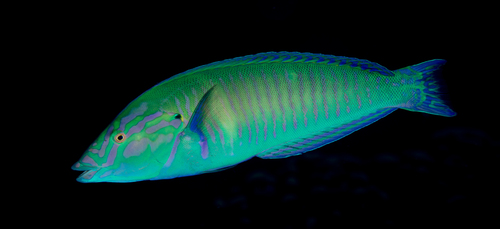
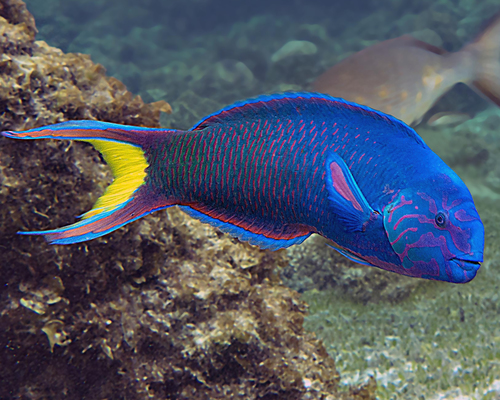
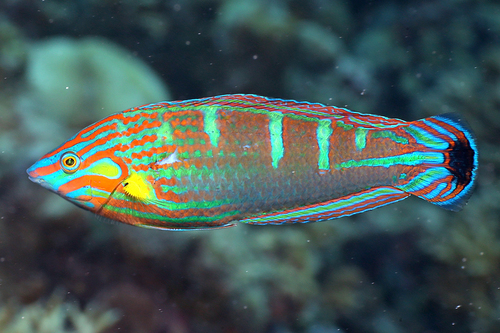
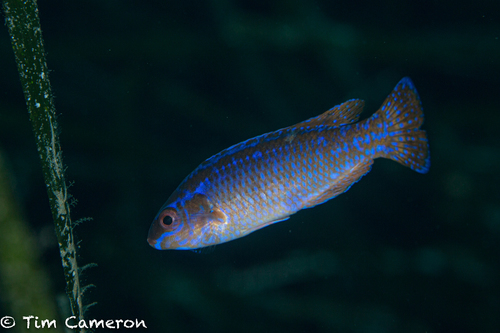
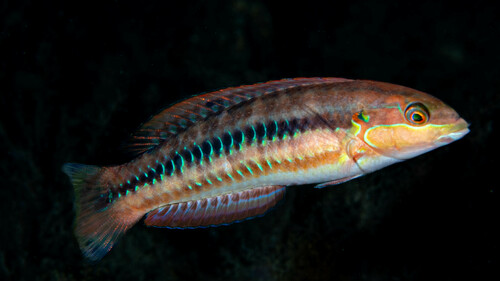
The slippery dick wrasse, Halichoeres bivittatus, is a small fish that can reach a maximum total length of 35 cm (14 inches). It has a thin, elongated body with a terminal mouth. Over its lifetime, this species goes through three distinct body coloration phases. The terminal phase occurs when the fish matures into a male: the body becomes green with two dark longitudinal stripes, the head and tail are marked with pink lines, and a small black spot sits above the pectoral fin. The initial phase occurs when a juvenile matures into a female: the main body background color is whitish with a pink tint, and the sides have two dark longitudinal stripes. The upper stripe is typically black, running from the snout through the eye to the base of the tail. A second, paler lateral stripe runs along the lower side of the body. Where the upper stripe crosses the gill edge, it has a bicolored spot that starts green and yellow and later turns black; this spot is present in all life phases. Intermediate individuals show extensive color variation, ranging from light purple to dark brown shades. Juveniles are usually white with two dark stripes, though the lower abdominal stripe may be faint, retaining the two longitudinal stripes and the spot above the pectoral fin seen in the initial phase. The slippery dick wrasse is widespread across tropical and subtropical waters of the western Atlantic Ocean, ranging from North Carolina and Bermuda south to Brazil, including the Gulf of Mexico and the Caribbean Sea. It is generally a reef-associated species found at depths between 1 and 15 meters (3.3 to 49.2 feet), and is uncommon in seagrass habitats. Both terminal phase and initial phase males are able to reproduce. Terminal phase males usually spawn in pairs within defended territories, while initial phase males typically spawn in large groups. Terminal phase males may occasionally join group spawning events, and initial phase males sometimes interfere with the pair spawning of terminal phase males. This species forms leks during the breeding season. In North Carolina, males defend temporary breeding territories, with peak spawning occurring in May and June. Pair spawning most often occurs between females and terminal phase males, and initial phase males occasionally attempt to insert themselves into these spawning events.