About Halichoeres biocellatus Schultz, 1960
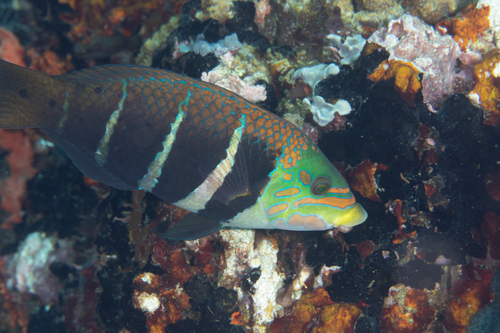
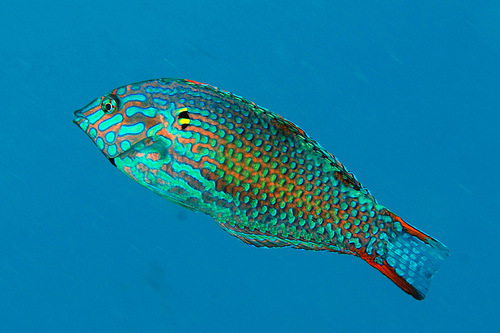
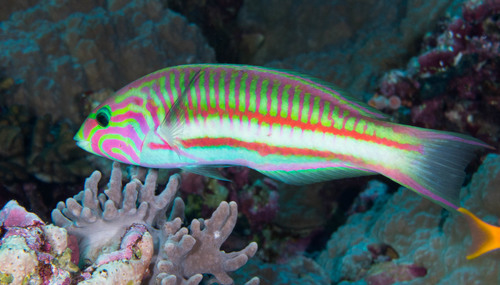
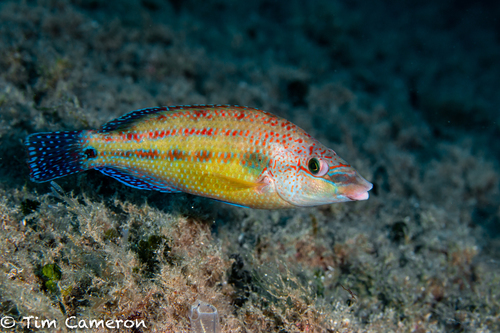
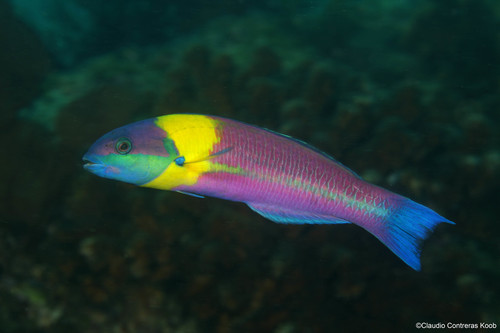
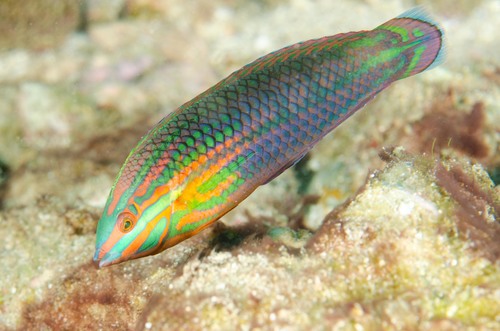
Red-lined wrasses (Halichoeres biocellatus Schultz, 1960) reach a maximum total length of approximately 12 cm (4.7 in). Mature males have a silvery grey body marked with narrow, longitudinal red stripes, and a distinct dark marking on the caudal peduncle. Females have narrow orange stripes that are continuous on the front portion of the body and intermittent on the rear portion. Both juvenile and female red-lined wrasses have two characteristic dark spots outlined in white on the dorsal fin: one positioned in the middle of the fin and one near the rear. These spots may fade as the fish matures. The species has a long, narrow dorsal fin that contains 9 spines and 12 soft rays, while the anal fin contains 3 spines and 11 to 12 soft rays. This species occurs in the tropical western Pacific Ocean, between 32°N and 24°S latitude, at depths reaching up to 35 metres (115 ft). Its documented range covers Japan, Indonesia, the Philippines, and Australia, where it is found along Australia’s northern coast from Western Australia to New South Wales. It typically lives on the seaward side of coral and rocky reefs that include sandy patches, and can also be found on reef slopes and reef crests made up of rock, rubble, and seaweed. Juvenile slender groupers (Anyperodon leucogrammicus) use aggressive mimicry to imitate red-lined wrasses. In this interaction, the grouper mimics the wrasse’s colouring and behaviour. This tricks prey fish into approaching the grouper, which they mistake for a harmless wrasse, allowing the grouper to attack.