About Haliastur sphenurus (Vieillot, 1818)
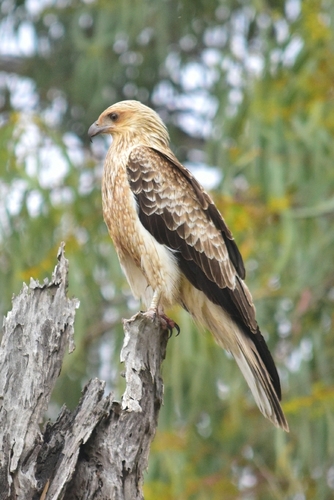
The whistling kite, with the scientific name Haliastur sphenurus (Vieillot, 1818), measures 50 to 60 cm (20 to 24 in) in body length, and has a wingspan between 123 and 146 cm (4 ft 0 in and 4 ft 9 in). Its body weight ranges from 380 to 1,050 g (0.84 to 2.31 lb), with an average weight of 600 to 750 g (1.32 to 1.65 lb) for males and 750 to 1,000 g (1.65 to 2.20 lb) for females. Like most raptors, female whistling kites are larger and heavier than males. There is considerable overlap in size between the two sexes, but females can be up to 21% larger and 42% heavier than males. Whistling kites that live in southern regions are also larger than individuals found in the tropics. Male and female whistling kites have identical plumage. Adults have pale buff coloration on the head, breast, and tail, with browner wing coverts and black flight feathers. Immature birds are heavily streaked reddish-brown, with prominent pale spots on the wings. Across all ages, whistling kites have unfeathered bone-colored legs and feet. Overall, the whistling kite has a small head and long tail, and when perched, its wingtips fall well short of the tip of its tail. While its legs are short, the species walks easily on the ground. When soaring, whistling kites hold their wings slightly bowed, and their long flight feathers are often well spread. A striking pattern on their underwings is a distinctive feature of the species. The whistling kite inhabits open or lightly wooded areas, and is typically found near water, at elevations from sea level up to 1400 meters. Most of the species stays in one area year-round, but some Australian individuals are nomadic. These nomadic birds wander to coastal areas of northern Australia during the dry season, while some south Australian birds migrate further south in autumn. There is some evidence that local populations of the species are declining in southern Australia, caused by wetland drainage and an associated drop in available food supplies.