About Halgerda terramtuentis Bertsch & S.Johnson, 1982
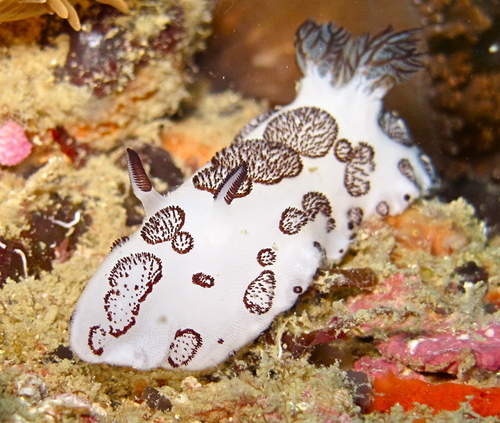
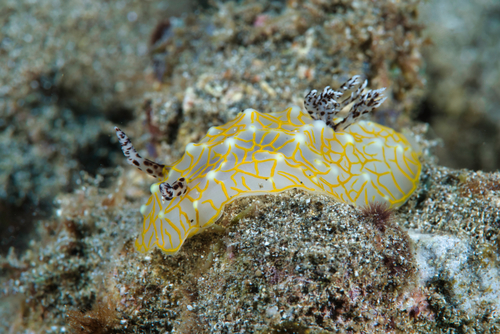
Halgerda terramtuentis was first described by Bertsch and S. Johnson in 1982. This species of nudibranch has an opaque white, slug-shaped body with a flat, jelly-like texture. Solid yellowish-gold lines run across the entire surface of the mantle, and these lines also appear along the edge of the muscular foot. Prominent white pustules form at every point where these lines cross. Its gills are whitish with black spot-like detailing. Fully grown individuals reach lengths between 15 mm and 50 mm. Halgerda terramtuentis are hermaphrodites, and mating involves combat between two individuals. The winner injects reproductive material into the mantle of the losing nudibranch to complete mating. After mating, females lay clusters of eggs covered in yellowish mucus. These eggs develop into veliger larvae, which eventually grow into mature, reproductively capable adults. This species is endemic to the Eastern Central Pacific, where it is restricted to the Hawaiian archipelago. It occurs on five major Hawaiian islands: Hawaiʻi, Maui, Lanaʻi, Oʻahu, and Kauaʻi, and is also found on the remote islands of Niʻihau and at the French Frigate Shoals. These sea slugs live at depths between 5 and 30 meters underwater, close to overhanging rock structures and underwater caves.