About Halfordia kendack (Montrouz.) Guillaumin
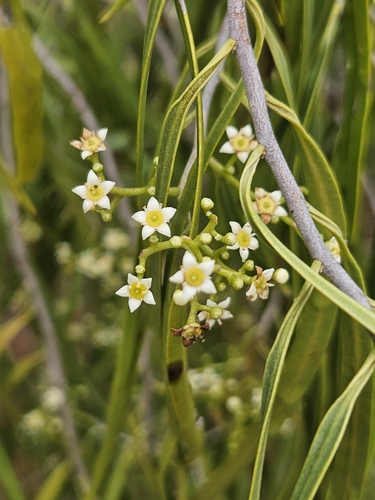
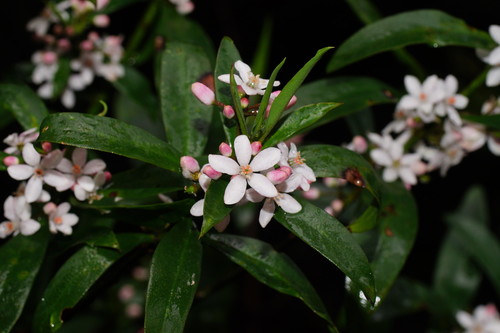
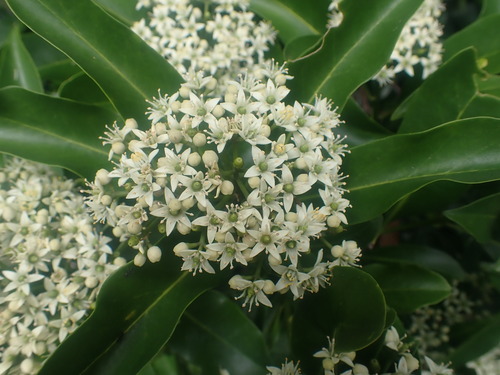
Halfordia kendack is a species of shrub or tree that typically grows 25–30 m (82–98 ft) tall, with a trunk up to 75 cm (30 in) in diameter that is often flanged at the base. Its bark is grey or pale yellowish-brown, marked with corky pustules, and is usually rough and wrinkled. Smaller branches are smooth, green, and around 13 mm (0.51 in) thick. Leaves are arranged in opposite pairs, ranging in shape from elliptical to egg-shaped or lance-shaped with the narrower end at the base. They are 50–180 mm (2.0–7.1 in) long and 10–50 mm (0.39–1.97 in) wide, and are either nearly sessile or borne on a petiole up to 20 mm (0.79 in) long. Each leaf tapers toward its base and ends in a rounded or tapered tip. New leaves have a distinct aromatic scent similar to eau de cologne, and the leaf tissue contains many conspicuous, closely spaced oil dots. Flowers are arranged in panicles 30–80 mm (1.2–3.1 in) long, with each flower around 11 mm (0.43 in) in diameter, growing from a pedicel 2–3 mm (0.079–0.118 in) long. Sepals are 0.5–1 mm (0.020–0.039 in) long, while petals are white, greenish white or yellowish, 4–6 mm (0.16–0.24 in) long, and covered in short, soft hairs pressed against the outer surface. Flowering occurs from January to May, and the fruit is a purple to bluish black drupe, spherical to oval in shape, 8–12 mm (0.31–0.47 in) long. Fruits can be present on the plant in most months of the year. Halfordia kendack, commonly called kerosenewood, grows in monsoon woodland and rainforest in coastal and inland areas, from sea level up to 1,260 m (4,130 ft) in altitude. It is native to New Caledonia, New Guinea and eastern Australia. In Australia, its range extends from the Torres Strait Islands to Cape York Peninsula in Queensland, south to Iluka in New South Wales, including the Mcpherson and Tweed Ranges. In its ecology, the hard seed of the fruit is surrounded by pulp that is eaten by a range of bird species, including the green catbird, topknot pigeon and wompoo fruit dove. Seed germination for this species can be difficult and often erratic. Before fibreglass and carbon fibre were developed, the timber of Halfordia kendack was used to make fishing rods. The timber is oily, flexible, hard, and has a density of 1100 kg per cubic metre. This species is growing in popularity as a horticultural plant. Its wood is highly flammable, and wood chips can be used to start a fire even when wet — this property gives rise to its common name "kerosene wood".