About Haldea striatula (Linnaeus, 1766)
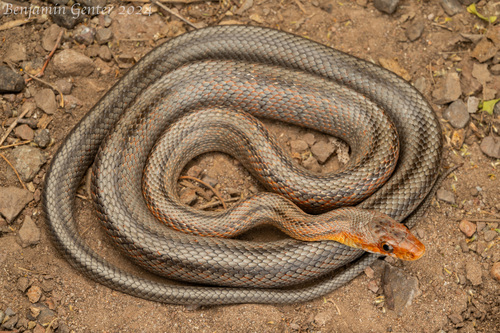
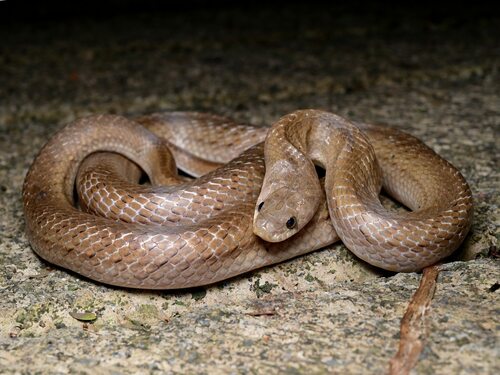
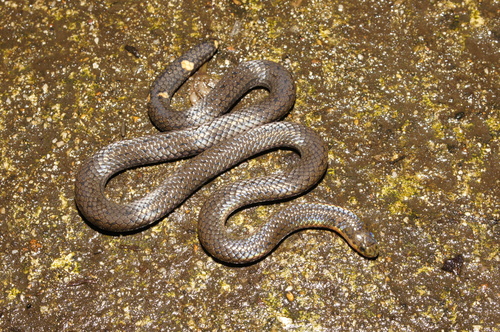
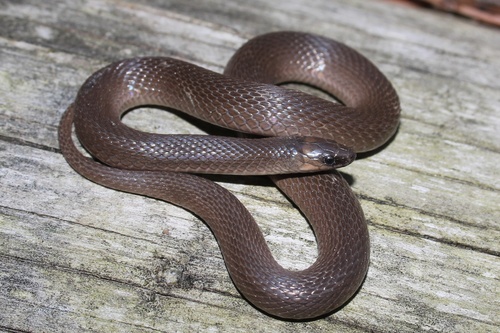
Haldea striatula (common name rough earth snake) is a small, harmless, secretive, fairly slender snake, reaching 7–10 inches (18–25 cm) in total length including the tail. It has round pupils, weakly keeled dorsal scales, and usually a divided anal plate. Dorsally, it is brown, gray, or reddish, and has essentially no distinct pattern. Females are slightly longer and heavier than males, with relatively shorter tails. Young individuals often have a light band on the neck, which is normally lost as they mature. The belly is tan to whitish, and its color does not have a sharp boundary with the back, which distinguishes it from wormsnakes (Carphophis amoenus) and red-bellied snakes (Storeria occipitomaculata). Keeled scales separate the rough earth snake from the similar smooth earth snake (Virginia valeriae) as well as from the wormsnake. This species is most often confused with De Kay's brown snake (Storeria dekayi), which is slightly larger, light brown with dark markings on the back and neck. Unlike the rough earth snake, De Kay's brown snake retains these dark markings into adulthood, and De Kay's brown snake also has a rounder snout than Haldea striatula. The rough earth snake’s geographic range extends from southern Virginia to northern Florida, west along the Gulf Coast to southern Texas, and north into south-central Missouri and southeastern Kansas. It is also found in northern parts of Oklahoma. The rough earth snake is fossorial, and hides beneath logs, rocks, or ornamental stones, in leaf litter, or in compost piles and gardens. It occurs in a variety of forested habitats with abundant ground cover, as well as in many urban areas. It can reach very high population densities in urban gardens, parks, and vacant lots. Haldea striatula is gonochoric and viviparous. It gives birth to 3 to 8 live young in mid-summer, and newborns measure about 10 cm (4 inches) in total length. The young somewhat resemble ring-necked snakes (Diadophis punctatus) with a light-colored neck collar, but they are much drabber and lack a brightly colored belly. Many sources classify live-bearing snakes as either ovoviviparous or viviparous. In reality, the distinction between these two terms is not very clear, and the diversity of reproductive modes is better understood as a spectrum or continuum between matrotrophy, where embryonic nutrients come directly from the mother, and lecithotrophy, where embryonic nutrients come mostly or completely from egg yolk. Viviparity is the most extreme form of matrotrophy, while oviparity is the most extreme form of lecithotrophy.