About Halcyon smyrnensis (Linnaeus, 1758)
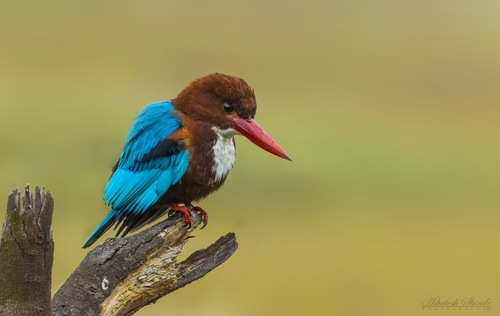
This species is the white-throated kingfisher, with the scientific name Halcyon smyrnensis (Linnaeus, 1758). It is a large kingfisher, measuring 27–28 cm (10.6–11.0 in) in length. Adult individuals have a bright blue back, wings, and tail. Their head, shoulders, flanks, and lower belly are chestnut-colored, while their throat and breast are white. Their large bill and legs are bright red. Their flight is rapid and direct, with short rounded wings moving in a whirring motion. When in flight, large white patches can be seen on their blue and black wings. Males and females have similar plumage, but juvenile birds are a duller version of adults. This species forms a superspecies with Halcyon cyanoventris, and most major taxonomic works recognize four geographic races. These races vary clinally in size and the shade of blue on the mantle: the mantle is more greenish in the smyrnensis and fusca races, and more blue or purplish in the saturatior race. The race H. s. gularis native to the Philippines only has white on the neck and throat, and is sometimes treated as a separate species, H. gularis. The race fusca is found in Peninsular India and Sri Lanka; it is slightly smaller, bluer, and has a darker brown underside than the nominate smyrnensis race, which is found in northwestern India. The race saturatior is found in the Andaman Islands; it is larger with darker brown underparts. The race perpulchra, which is not always recognized as a valid race, is found in northeastern India; it is smaller than fusca with paler underparts. Cases of albinism have been noted occasionally in this species. The white-throated kingfisher is a common species that lives in a variety of habitats, mostly open country in the plains, though individuals have been seen at 7500 ft in the Himalayas. It occupies areas with trees, wires, or other perches. The species' overall range is expanding. The white-throated kingfisher is widespread, and its populations are not considered threatened. An average density of 4.58 individuals per km² has been recorded in the Sundarbans mangroves.