About Halcyon senegaloides A.Smith, 1834
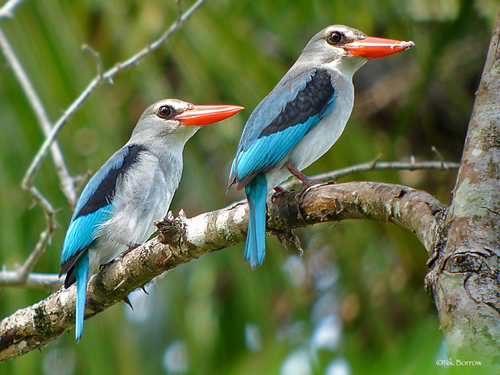
Halcyon senegaloides, commonly called the mangrove kingfisher, measures approximately 22 cm (8.7 in) in total length. Adult males and females have identical plumage. Adult individuals have a dark grey-brown head, black lores, a narrow white stripe above the eye, and brown-grey cheeks and neck sides. Their grey breast and flanks have vermiculation, which is a pattern of dense, irregular fine lines. A distinct black patch is present under the wing. The rest of their plumage matches that of the woodland kingfisher, with black and blue covert and flight feathers. Adult mangrove kingfishers have a red beak, dark brown eyes, and dark grey-brown legs. Juvenile birds are duller in overall coloration, have coarser vermiculations, a yellowish-buff tint on the breast, and a brown beak. Southern populations of this species tend to have slightly longer wings and narrower beaks than other populations. This species is distributed along the eastern coast of Africa, ranging from Somalia south through Kenya, Tanzania, and Mozambique to South Africa. A single individual has been officially recorded in eastern Zambia. It most often occurs within 20 km (12 mi) of the coast, but can also be found inland along the Jubba and Zambezi rivers. The mangrove kingfisher is classified as a partial migrant. When not breeding, it inhabits estuaries, mangroves, wooded shores, thornveld, forest, cultivated land, parks, and gardens. For breeding, it leaves coastal estuaries and mangroves and moves to woodland and wooded river habitats, which are typically located further inland. The only exception to this pattern is breeding populations in the Zanzibar Archipelago.