About Halcyon pileata (Boddaert, 1783)
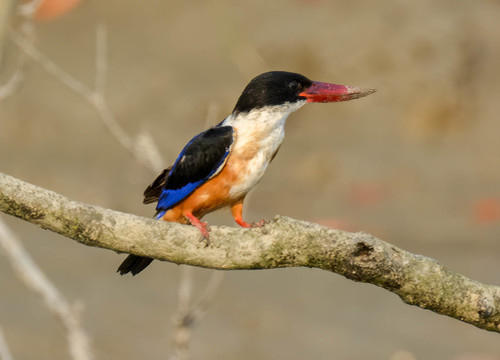
Halcyon pileata, commonly called the black-capped kingfisher, reaches approximately 28 centimetres (11 inches) in total length. Adult individuals have purple-blue wings and back, a black head and shoulders, a white neck collar and throat, and rufous-colored underparts. Their large bill and legs are a bright shade of red. When in flight, large white patches known as "mirrors" at the base of the primary flight feathers are clearly visible on the blue and black wings. Males and females have similar plumage. Juvenile birds are a duller version of adult plumage, and they also have visible streaks on their throat. The call of this kingfisher is a cackling ki-ki-ki-ki-ki. This kingfisher is typically found around coastal waters, and especially in mangrove habitats. It is easily disturbed by nearby activity. It perches in open, conspicuous spots, dives into water to catch fish, and also feeds on large insects. Its flight is rapid and direct, with short rounded wings that produce a whirring sound when moving. Its breeding season takes place in summer. The nest is a tunnel dug into an earthen bank, and a typical clutch consists of 4 to 5 round, white eggs. One subspecies named palawanensis has previously been described, but the species is currently considered monotypic, as no clear consistent plumage differences have been documented across its range. This species occurs primarily near the coast, in mangrove forests, and alongside estuaries and rivers. Its distribution extends from India, including the Andaman and Nicobar Islands where it can be found even on remote islands such as Narcondam, through Sri Lanka, Kansu, Shansi, Korea, the Malay Peninsula, Thailand, Burma, the Ryukyu Islands, Bangladesh, Hainan, the Philippines (Palawan, Balabac, Basilan, Tawi Tawi), Borneo, and Sumatra, reaching east to Sulawesi where it only occurs during the winter. Vagrant individuals have been recorded in Pakistan during winter, and rainfall-related movements may lead this species to appear far inland, outside of its usual distribution range.