About Halcyon malimbica (Shaw, 1812)
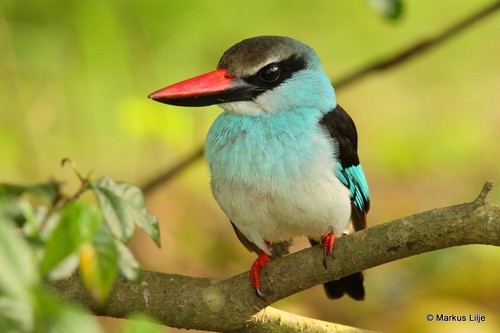
The blue-breasted kingfisher, scientifically named Halcyon malimbica (Shaw, 1812), is a tree kingfisher that is widely distributed across Equatorial Africa. This species is essentially resident, though it retreats from drier savanna areas to wetter habitats during the dry season. It is a large kingfisher, reaching 25 cm in length. Adult blue-breasted kingfishers have bright blue coloring on their heads, backs, wing panels, and tails. Their underparts are white, with an added blue breast band, and their shoulders are black. This kingfisher’s flight is rapid and direct. It has a large bill with a red upper mandible and a black lower mandible, and its legs are bright red. Male and female blue-breasted kingfishers look similar, while juvenile individuals are duller in color than adults. This is a noisy kingfisher, and its call is a whistled pu-pu-pu-pu-ku-ku-ku-ku. The blue-breasted kingfisher lives in a variety of well-wooded habitats. When seeking food, it perches quietly in deep shade. It is territorial, but also wary. This species mainly hunts large insects, arthropods, fish, and frogs, but it will also eat the fruit of the Oil Palm. It performs a striking courtship or territorial display where it spreads its wings to reveal their white linings. Its nest is a hole made in a tree termite nest. A typical clutch consists of just two round white eggs.