About Halcyon gularis (Kuhl, 1820)
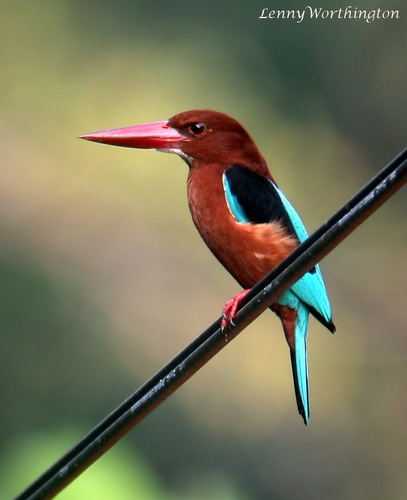
Halcyon gularis, commonly called the brown-breasted kingfisher, is a fairly large kingfisher found in lowland and foothill open country and forest edge. According to eBird, its underparts, hood, and area down to the upper back are chocolate brown. Its back, tail, and wings are bright blue, with large black shoulder patches, small black wingtips, a white throat, and bright red legs. It is somewhat similar to the Stork-billed Kingfisher, but the brown-breasted kingfisher has chocolate brown rather than orange underparts. Its song is a rapid, descending series of around a dozen sharp notes, that trails off in volume. This species was previously treated as a subspecies of the white-throated kingfisher (H. smyrnensis). The IUCN Red List and BirdLife International split it into a distinct species in 2014, and the International Ornithological Congress followed this change in 2022. It is distinguished from the white-throated kingfisher by its plumage: white is restricted only to the chin, rather than extending to the breast as in the white-throated kingfisher. It also has more black on the wings and a shorter tail. This species is monotypic. Its broad range of habitats includes clearings, fishponds, rivers, second growth scrubland, and forest edge. It is typically found below 1,000 meters above sea level. The IUCN has not yet classified this species separately from the white-throated kingfisher. The species is common across its range, has adapted well, and even benefits from human-modified habitats. Despite massive deforestation in the Philippines, this species' adaptability has allowed it to survive and even thrive better than most Philippine birds. It feeds on insects, reptiles, amphibians, fish, small birds, small mammals, and occasionally bats. It typically perches 5 to 10 meters above its hunting area, then swoops down to catch prey. Its breeding season falls around April to May, when it typically nests in termite mounds and lays 2 to 4 eggs.