About Halcyon cyanoventris (Vieillot, 1818)
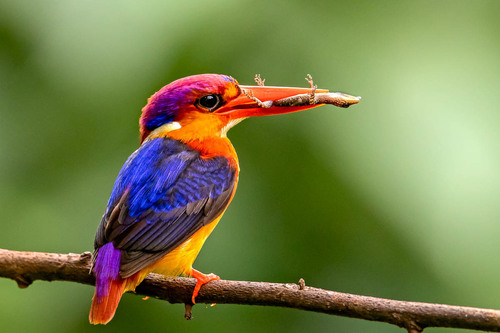
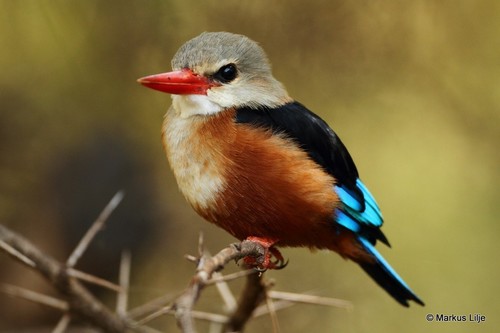
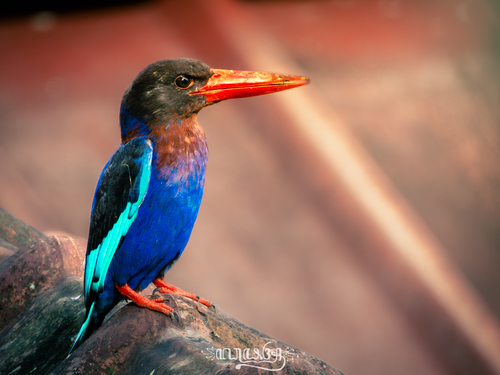
The Javan kingfisher, scientifically named Halcyon cyanoventris (Vieillot, 1818), is a medium-sized bird that reaches 25–27 cm in length at maturity. It has a distinctive large red bill, dark brown irises, head, throat, and collar, a purple body, vivid turquoise primary coverts, secondaries, and tail, white wing patches on the bases of the primaries that are visible in flight, and dark red feet. No significant sexual dimorphism has been reported for this species. Juvenile Javan kingfishers have duller overall colouring, brownish-orange bills, and whitish throats. Juveniles of the Halcyon genus often display light barring or mottling on areas that are solidly coloured in adult individuals. The Javan kingfisher’s call is locally described as cekakakak cekakakak cekakakak, which gives the bird its local common name Cekakak, along with similar variant names. Other sources describe the call as a far-carrying, striking, commonly heard scream that is quieter than the call of the collared kingfisher. Alternative published transcriptions of the Javan kingfisher’s call include tjie-rie-rie-rie-rie-rie, chee-ree-ree-ree, and cheree-cheree. Javan kingfishers are endemic to the Indonesian islands of Java and Bali, and are a non-migratory species. They occupy a wide range of habitats: pastures, fish ponds, paddyfields, marshes, coastal scrub, mangroves, open dry forest, municipal parks and gardens, and orchards. While they live in some coastal environments, they generally avoid direct contact with seawater. They typically avoid humid tropical forests with closed canopies, except in areas where roads or human development have created the open spaces the kingfishers need to hunt. Urban and suburban areas with adequate tree cover can also make suitable habitat for this species. Unlike many other kingfisher species, the Javan kingfisher does not seem to be strongly dependent on being close to a body of water. It is most often found at elevations below 1,500 m (4,900 ft) above sea level, though one study recorded the species at nearly 2,500 m (8,200 ft) on Mount Lawu in East-Central Java.