About Halcyon coromanda (Latham, 1790)
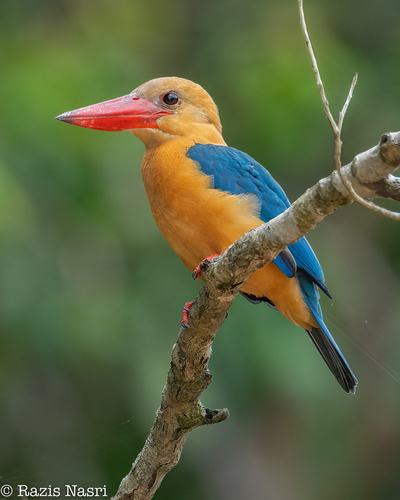
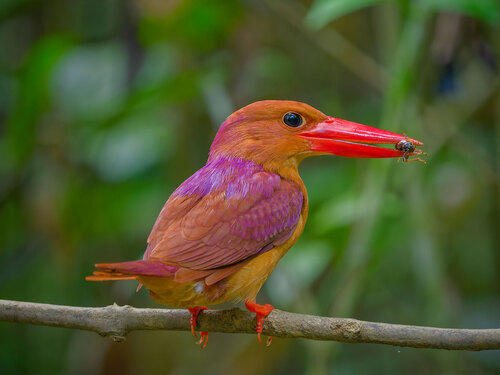
The ruddy kingfisher, with the scientific name Halcyon coromanda (Latham, 1790), reaches approximately 25 cm in length. It has a very large bright red bill and matching red legs. Its body is rust red, which generally deepens to purple at the tail. There is little sexual dimorphism in this species, though some sources note that male birds tend to have somewhat brighter plumage. Because the ruddy kingfisher prefers heavily forested areas, its high, descending call is more often heard than the bird itself is seen. These birds generally travel singly or in pairs. The species ranges from South Korea and Japan in the north, south through the Philippines to the Sunda Islands, and west to China and India. It is migratory; birds in the northern part of its range migrate as far south as Borneo during winter. It is locally common in the southern parts of its range, but rare in Japan, where it is highly sought after by birders. Ruddy kingfishers inhabit forested areas from temperate to tropical zones, and are often found in thick jungles and rainforests. The binomial name references the Coromandel Coast of India. Like other kingfishers, ruddy kingfishers generally feed on fish, crustaceans, and large insects. However, in areas with less running water, they are known to eat frogs and other amphibians.