About Halcyon chelicuti (Stanley, 1814)
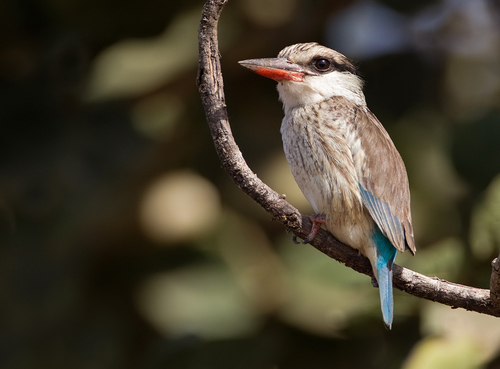
The nominate subspecies of the striped kingfisher, Halcyon chelicuti chelicuti, averages 16 to 18 cm (around 6.5 inches) in total length from beak to tail. When perched, adult individuals of this subspecies have mostly greyish brown upper bodies. The lower back, secondary flight feathers, and tail are metallic blue; this blue color, along with a white patch at the base of the primary flight feathers, is far more visible when the bird is flying than when it is perched. The wing linings are white with a black border, and males have an additional black bar at the base of the primaries. The bird's underparts are off-white, with a buffier tone on the breast. Kenyan birds have brown streaks only on their flanks, while southern African birds have brown streaks on both the sides and breast. The top of the head is also streaked with dark brown; the background color of the crown is buffy grey in males and brownish in females. The sides of the head, throat, and a collar wrapping around the back of the neck match the off-white color of the underparts. A black line runs around the back of the neck, above the white collar, and passes through the eyes. The upper mandible and tip of the bill are blackish, while the rest of the lower mandible is reddish-orange. Juvenile striped kingfishers resemble adults but are paler overall. They have less blue on the wings, a darker crown, dusky tips on the breast feathers, and dull red coloring on the lower mandible. The call of the striped kingfisher is distinctive, described as either a high-pitched, piercing "cheer-cherrrrrr" or a far-carrying "KEW, kerrrrrrrrr", where the repeated 'r' sounds stand for a descending trill that is lower in pitch than the first note. Calls are often given at dusk during a display in which the bird opens its wings. The northern subspecies, H. c. eremogiton, has a grey-brown crown and mantle, and underparts that are almost entirely unstreaked. This species is found across Sub-Saharan Africa, absent from dense forests (especially those near the Congo River), the Horn of Africa, the Namib Desert, and South Africa. It favors woodland, thorn scrub (thornveld), dry bush, and open savanna, and avoids areas of intensive farming. Two subspecies are recognized: H. c. chelicuti occupies most of the species' range, while H. c. eremogiton, described by Hartert in 1921, lives in the northern desert parts of the range from central Mali to the White Nile region of eastern Sudan. The two subspecies hybridize in southern Mali. When displaying, a mated pair of striped kingfishers sits facing each other in a treetop with their tails held cocked. They flick their wings open and shut while vocalizing; their pee-hee song gradually shifts into a sequence of short trills and pauses. The female lays her eggs in a disused woodpecker or barbet hole. Both sexes take turns incubating the eggs during the day, but only the female incubates at night. The male feeds the female, holding prey items in place while the female tears off pieces to eat. Up to a quarter of all striped kingfisher nests are parasitized by lesser honeyguides and greater honeyguides. This species is usually monogamous, though cases of polyandry have been recorded. Striped kingfishers normally raise two broods per breeding season. The diet of the striped kingfisher consists mostly of grasshoppers, followed by other large insects. Small lizards, snakes, and rodents are taken occasionally. It hunts from a perch around 3 meters (10 feet) high, swooping down to the ground to catch prey up to ten times per minute. Prey is carried back to the perch to be swallowed; large prey is beaten vigorously against the perch first. When bringing grasshoppers to nestlings, adults present the prey head-first, similar to how aquatic kingfishers deliver fish to their chicks.