About Halcyon badia J.Verreaux & É.Verreaux, 1851
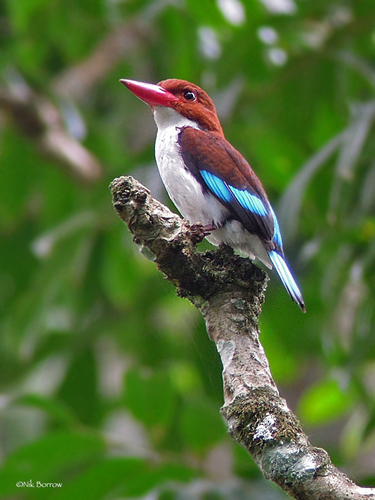
Scientific name: Halcyon badia J.Verreaux & É.Verreaux, 1851. Description: The chocolate-backed kingfisher has the typical stocky kingfisher body shape, with dark upper parts and pure white underparts. Its head and hind neck are very dark brown, the mantle is brownish black, the back is black, the rump is a brilliant iridescent blue, the upper tail coverts are black, and the tail is pale blue. The wings are dark, except for a brilliant azure speculum formed in the outer webs of the secondary feathers. Its underparts, from the throat to the vent, are snowy white, with the exception of a small blackish flank patch, and are clearly divided from the dark upper parts. In flight, the bright blue rump and speculum are distinctive features. The bill is red or reddish brown. Juveniles are similar to adults, differing in that the juvenile breast is scalloped, and the juvenile bill is blackish with an orange tip. Distribution: The chocolate-backed kingfisher lives across the African tropical rainforest. It can be found west of the Dahomey Gap from Sierra Leone to Ghana, then from southern Nigeria east to southern Central African Republic and western Uganda, and south to the Kwango River in northern Angola. It also occurs on Bioko. Habitat: The chocolate-backed kingfisher is not associated with water, and it inhabits primary and secondary lowland rain forest.